Your First Surf Lesson in Santa Teresa: Which Beach, and Which Hour
Santa Teresa is one long road with several very different beach breaks. Pick the wrong stretch and your first morning is spent being tumbled. Here is how to choose.
 Marta Daví
Short answer: book your first lesson at Playa Hermosa, the wide beach at the north end of Santa Teresa. It has sand underfoot and waves that roll rather than slam. Playa Carmen, at the main intersection, works on a small day and is the easiest to walk to. The punchier breaks in the middle of town are not where you learn to stand up.
That is the whole decision, and almost no guide makes it for you. Most Santa Teresa surf pages list every break with a skill label beside it, which is useful if you already surf and useless if you have never been pushed into a wave. The question a first-timer actually has is narrower: on the days I am here, with no car and one morning to spare, where should my lesson be and who should run it?
Santa Teresa is one road, and the waves change along it
There is no grid here. A single road runs parallel to the sand from Mal Pais in the south, through Playa Carmen where the road in from Cobano meets the coast, on through the town stretch, and out to Playa Hermosa in the north. Your beach is chosen by where along that road you stand.
| Stretch | Who it suits | What to know |
|---|---|---|
| Playa Hermosa (north) | First lessons, longboards, nervous beginners | Wide and sandy with a gentler, more forgiving wave. Most schools drive students here when town is working against them. |
| Playa Santa Teresa (town) | Improvers who can already paddle and turn | Faster and heavier. This is where the photos of real barrels come from. |
| Playa Carmen (the intersection) | Beginners on a small day, anyone without wheels | Walkable from most of the town's hotels and restaurants. Good push on a small swell, messy when it is big. |
| Mal Pais (south) | Experienced surfers, rockier entries | Not a learning beach. Go for the quiet, not the first lesson. |
A note worth filing away before you book a hotel by the wrong name: Playa Hermosa near Santa Teresa is not the Playa Hermosa in Guanacaste, which is four hours and a ferry away up the coast. Two beaches, one name, regularly booked in error.

Is a lesson worth it, or should you just rent a board?
Rent a board and you will spend the morning learning where the water is not shallow. Take a lesson and someone who read this beach yesterday puts you in the right spot, reads the sets, and pushes you into waves you cannot yet see coming. For a first time on a Pacific beach break, that is the difference between standing up and swallowing half the ocean.
Two practical reasons beyond technique. First, a school puts you on a soft-top foam board, which is the only board that forgives a fall onto your own equipment. Second, an instructor positions the group away from the rip currents that pull along any open beach break, and keeps you between two markers instead of drifting a kilometre down the sand without noticing.
If you already surf and simply want waves, skip the lesson and ask a local shop which end of the road is working that day. If you have never stood on a board, the lesson is the thing you are buying, not the board.
Toorizta's beginner session on this coast is called Learn to Surf at Paradise Beach. Message us with your dates and we will tell you which stretch your group should be on, and on which morning.
Which hour? The tide decides, not the clock
Schools here do not run on a tidy 9am timetable, and when one tries to, beginners pay for it. A beach break changes character across the tide: the same sandbar that gives a soft, slow shoulder at one stage of the water will close out and dump at another.
So the useful question when you book is not "what time do you start?" but "what time are you starting on Thursday, and why?" A school that answers with a tide reason is a school worth your morning. A school that answers 10am every day of the week is selling you a slot, not a session.
Size is a week-by-week matter on this coast rather than a month-by-month one. Tell us the dates you are in Santa Teresa and we will tell you honestly whether the forecast points to a Hermosa morning, a Carmen morning, or a week where the lesson goes early before the wind arrives.
What the first hour actually looks like
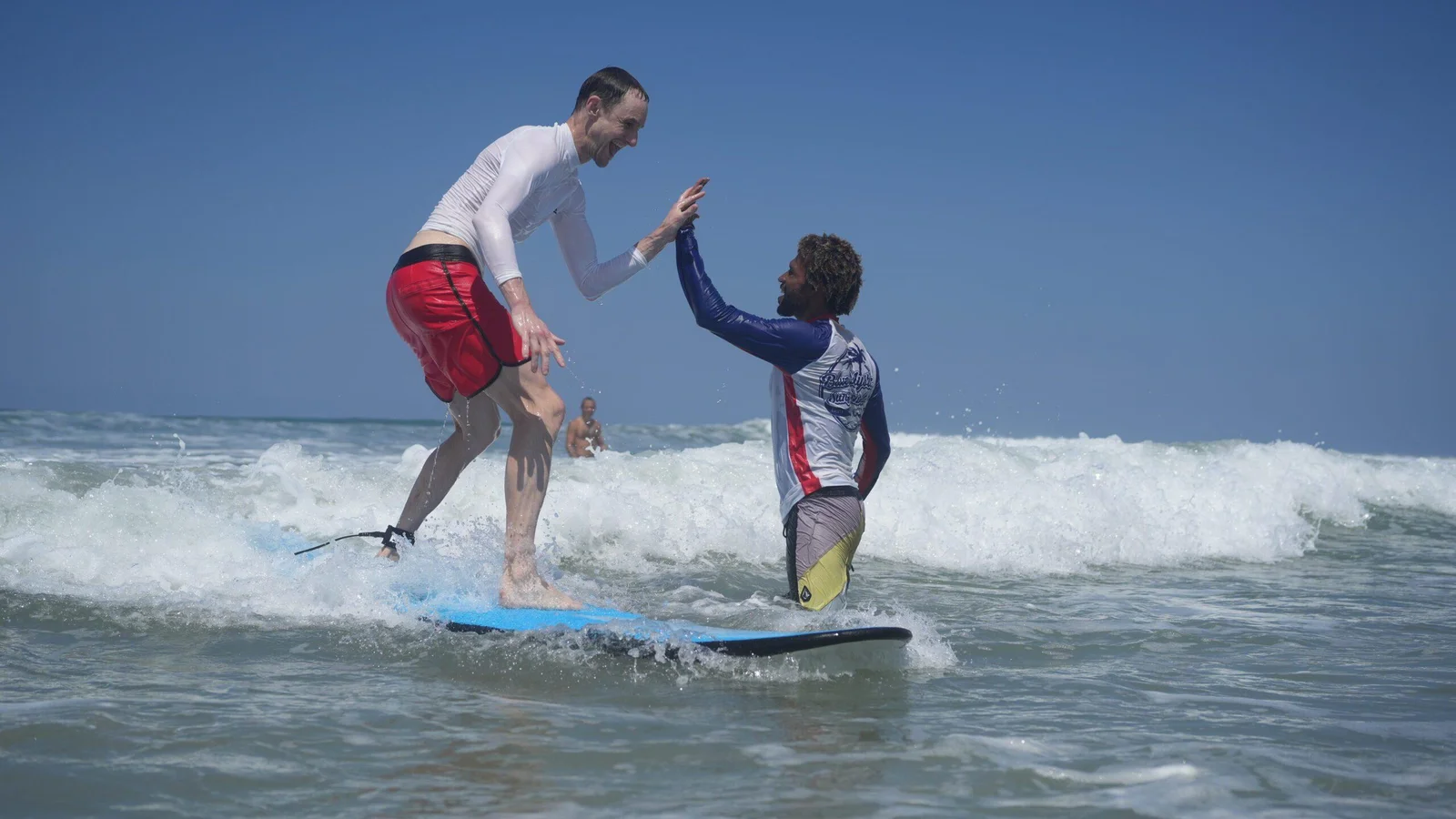
You start on dry sand, which feels slightly silly and is the part that saves you later. Board flat, feet marked in the sand, three pop-ups while a howler monkey complains from the almond trees behind the beach. Then you walk the board out past the shore break, turn to face the beach, and wait with your instructor's hand on the tail.
The first wave does not feel like surfing. It feels like a lift from behind and a lot of white noise. Somewhere in the second or third one, you stop thinking about your feet and the board simply goes, and you are standing in warm water looking at a line of trees. That is the moment people come back for.
Expect to be tired in a way that surprises you. Expect sand in places you will find on the flight home. Expect, if you are the sort of person who likes a plan, to book the second lesson before dinner.

When the swell is too big to learn on
Some weeks the ocean simply says no, and a good instructor will tell you so rather than take your money. Santa Teresa has one excellent answer for that morning, and it sits at the end of the road.
Cabo Blanco Absolute Natural Reserve is the oldest protected area in Costa Rica and the forest is thick with coatis, howlers and seabirds. Plan it carefully, because it is not open daily. SINAC's published entrance fee table for protected areas lists Cabo Blanco as open Wednesday to Sunday, 8am to 4pm, with admission of $12 for non-residents and 1,600 colones for residents (source: SINAC, Tarifas de ingreso a areas silvestres protegidas, sinac.go.cr). Closed Monday and Tuesday, which catches a lot of people whose flat day happens to be Monday.
The other move is east over the hill to Montezuma for the waterfall and a different, quieter kind of day. If you are still deciding where to sleep on this side of the peninsula, our guide to where to stay in Santa Teresa breaks the road into pockets, and Montezuma or Santa Teresa for a group compares the two towns directly.
Getting here, briefly
Santa Teresa is reached by ferry across the Gulf of Nicoya and then a drive over the hills through Cobano, or by small plane to Tambor. The crossing you catch sets what time your first day starts, which matters if you want a lesson that same afternoon. We wrote about which ferry crossing to aim for on the Montezuma route, and the same timetable governs the road to Santa Teresa.
Tell us your dates and we will pick the beach
We are Dallas and Marta. We plan Costa Rica trips for a living and we would rather send you to the right stretch of sand on the right morning than let you discover the wrong one at 8am on your only free day.
Send us a message with your dates, who is surfing, and whether anyone in the group has stood on a board before. We will tell you which beach, which hour, and what to do with the morning if the ocean has other plans. Pura Vida.
Toorizta is how modern travelers plan, book and share Costa Rica trips. Open the app to build your own.
Open the Toorizta app