Montezuma or Santa Teresa: Where Should Your Group Sleep?
Two southern Nicoya beach towns, one ridge road between them, and the choice that shapes every evening of your trip.
 Marta Daví
Four people, one rental house, and a group chat that has been arguing about Montezuma versus Santa Teresa for two weeks. The towns are close enough that everyone assumes it barely matters. It matters more than almost any other choice you will make on the southern Nicoya Peninsula, because it decides where your group eats dinner every single night.
The short answer
If your group wants to park the car and walk to dinner, book Montezuma. If surfing is the point, or if you want a real choice of restaurants after dark, book Santa Teresa, and pick the hotel by which stretch of the one coastal road it sits on. Splitting a short trip across both is the mistake.
Why the road between the two towns settles it
Montezuma and Santa Teresa sit on the same southern tip of the Nicoya Peninsula, on opposite sides of a ridge. There is no coastal road joining them. Every trip between the two runs inland and uphill to Cobano, the service town where the bank, the supermarket and the clinic are, then drops back down to the coast on the far side. None of that ridge route is lit.
Two things follow from that, and they are the whole article.
First, crossing the ridge is an easy errand at ten in the morning and an unwelcome one at ten at night. Nobody in your group will volunteer to drive it back after a beer at sunset.
Second, whichever town you book, your evenings belong to that town. You can borrow the other one for a beach day. You cannot borrow it for dinner.
What waking up in Montezuma is like
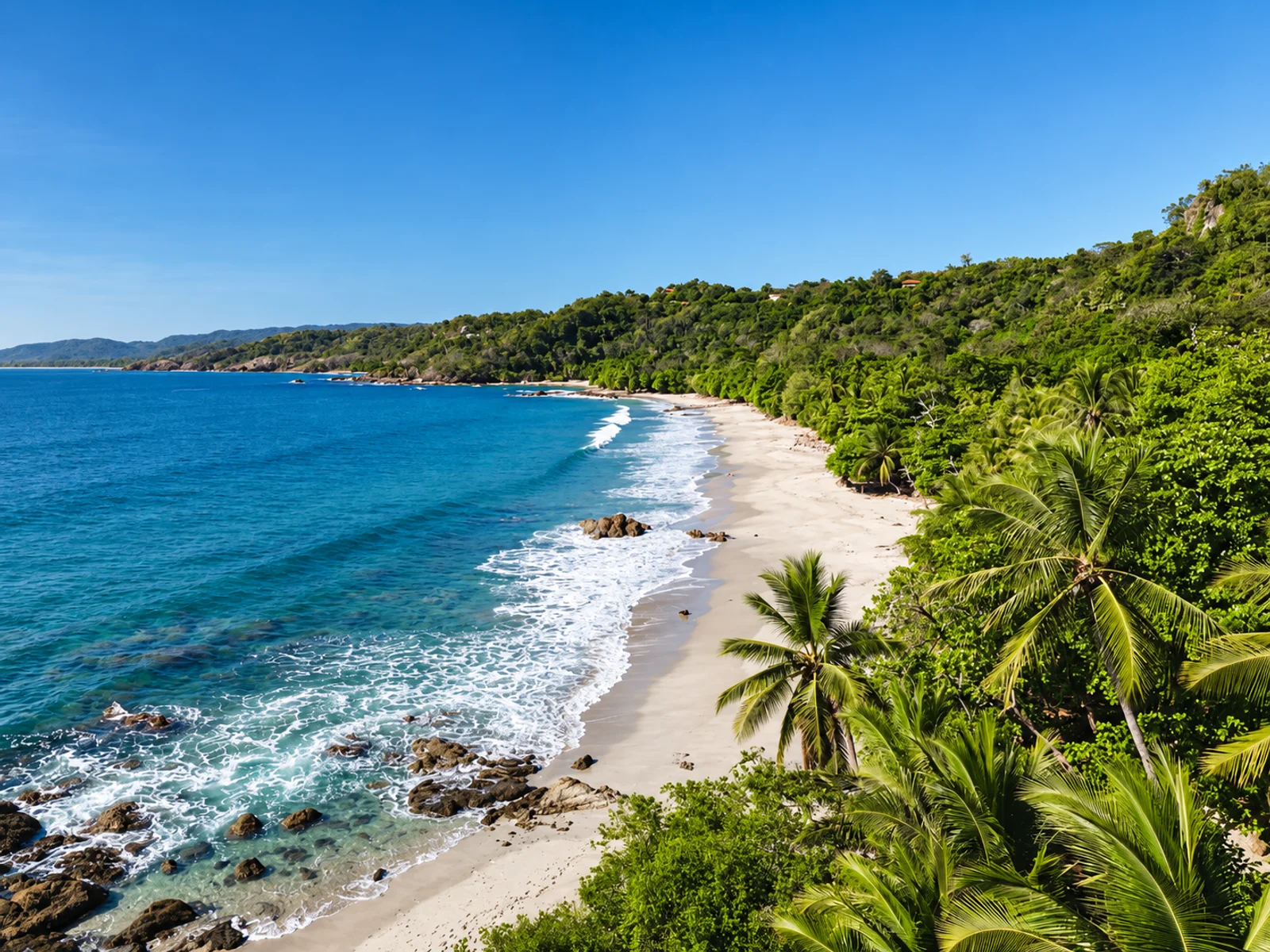
Montezuma is small in a way that is hard to grasp from a map. It is a handful of streets that run downhill and stop at the water. Howler monkeys work through the trees above the road before most kitchens open. Almost everything, the sodas, the bars, the fruit stand, the boat guys, sits inside a few blocks of each other.
That shape is the product. In Montezuma a group can arrive by shuttle, never rent a vehicle, and lose nothing. Dinner is a walk. The walk home is a walk. The waterfall trail starts from town and goes up the river behind it, so even your one big activity does not need wheels.
Be honest with the group about what Montezuma is not. It is not a surf town. The beaches around the village are beautiful and rocky in stretches, with water that deserves respect rather than a casual swim. Nightlife means a few bars where the same people keep turning up, not a strip. Groups who wanted variety at dinner sometimes run out of town by night three.
Montezuma suits mixed groups: the friends who surf and the friends who do not, the ones who want an early morning and the ones who want a late one, and anyone who would rather not put a vehicle in the plan at all.

Santa Teresa is not a town, it is a point on a road
This is the part the comparison guides skip. Santa Teresa is strung along a single coastal road that runs for kilometres, so "staying in Santa Teresa" tells you almost nothing. Where on the road you sleep is your entire week.
Roughly, from south to north: Mal Pais at the quiet end, Playa Carmen at the junction where the road from Cobano meets the coast and where much of the eating and shopping sits, then Santa Teresa proper, then Playa Hermosa further north and quieter again.
Sleep within a short walk of the Carmen junction and Santa Teresa behaves like a normal beach town: you walk to dinner, you walk home, and the surf is in front of you. Sleep a few kilometres out in either direction and every meal, every beer and every surf lesson becomes a ride. That ride is an ATV, a taxi or the rental car, and somebody in the group has to stay sober to drive it.

One thing has genuinely changed here. The Santa Teresa road was paved this year, so the dust that used to settle on every room, menu and surfboard within a few metres of it is no longer part of the decision. Older guides and older reviews still warn you about it. Ignore that part and spend your attention on the question that still matters, which is not which side of the road you are on but which end of it.
Santa Teresa suits surfers, groups who want to choose between ten dinners instead of three, and travelers who are happy to organise wheels.
Side by side
Montezuma | Santa Teresa and Mal Pais | |
|---|---|---|
Shape of the place | A few blocks running down to the water | One coastal road, kilometres of it |
Walk to dinner | Most stays are a few minutes on foot | Depends entirely on where on the road you sleep |
Surf | Not the reason to come | The reason most people come |
Evenings | Small, early, a handful of bars | More restaurants, later, busier |
Do you need wheels | You can skip them completely | Usually yes, or a daily ATV and taxi budget |
Best for | Mixed groups, non surfers, no car trips | Surfers, groups who want choice at dinner |
Watch out for | Running out of variety by night three | Booking a room that turns out to be a ride from everything |
What the stay actually costs your group
Four decisions move the number far more than the star rating does, and three of them are about position rather than the room.
Position on the road. In Santa Teresa, walking distance to the Carmen junction is the expensive part. A house with a pool a few kilometres out looks like a bargain until you add a week of rides and the surf lessons nobody booked because the board rental was too far away.
Season. December through April is the peak here and the popular houses go early. May through November is lusher, quieter and cheaper, with the tradeoff moving into the roads. Our green season guide sets out how that plays out across the country.
Wheels, or not. This is the real Montezuma discount. No 4x4, no fuel, no daily ATV rental, no ferry fare for a vehicle.
Rooms versus a house. Six friends in one house usually wins on price and loses on sleep. Two rooms in a small hotel in walking distance of dinner often beats a bigger house nobody can walk home to. We break the rest of the budget maths down in what a Costa Rica trip actually costs.
Cabo Blanco closes two days a week, so check before you plan your hiking day
Cabo Blanco Absolute Nature Reserve, the first protected area declared in Costa Rica, sits past Montezuma at the Cabuya end of the peninsula. According to SINAC's published entry fee and hours schedule, checked on 27 September 2026, Cabo Blanco is open Wednesday to Sunday from 8am to 4pm, with entry at $12 for non resident adults, $5 for non resident children aged 2 to under 12, and CRC 1,600 for nationals and residents. Fees and hours can change, so confirm before you go.
That closure is a planning fact, not a detail. Cabo Blanco is closed Monday and Tuesday. If your group has one day earmarked for a proper forest hike and that day is a Monday, the hike does not happen. Move the day, not the plan.
It is also the strongest argument for Montezuma as a base if your group cares about wildlife. From the Montezuma side the reserve is a short trip. From the far end of Santa Teresa it is the ridge crossing plus the run down to Cabuya, before you have walked a step.
If your group genuinely cannot agree
Split the week, but only if it is a week or more. Three nights in one town and four in the other works when you move in the morning, check out with the bags in the vehicle and treat the transfer day as a half day rather than a travel formality. On a five night trip the same split costs you most of a day and a second round of unpacking, which is a real price for a change of scenery you could have had on a day trip.
Our advice for most groups: pick one base, then use the other town for a deliberate day out with a return before dark.
Two other pieces worth reading if you are choosing a base rather than a hotel: where to stay in Drake Bay, which is the same decision with a boat instead of a ridge, and why couples choose their Caribbean base by the walk home. If the Nicoya as a whole is still open for you, the Nosara guide covers a third option further up the same coast.
What we would ask before telling you where to sleep
Four questions, and the answers usually decide it inside a minute.
How many of you are actually going to surf, and are any of you beginners?
Are you renting a vehicle, and is one person happy to be the designated driver most nights?
Which nights are you arriving and leaving, and what time does your group land?
Does anybody in the group want a real forest day, and which day of the week is free for it?
Tell us those four things and we will tell you which town we would book for your group, and which stretch of it. Ask us. We would rather talk you into the right base than watch you spend a week driving to dinner.
Pura Vida.
Toorizta is how modern travelers plan, book and share Costa Rica trips. Open the app to build your own.
Open the Toorizta app