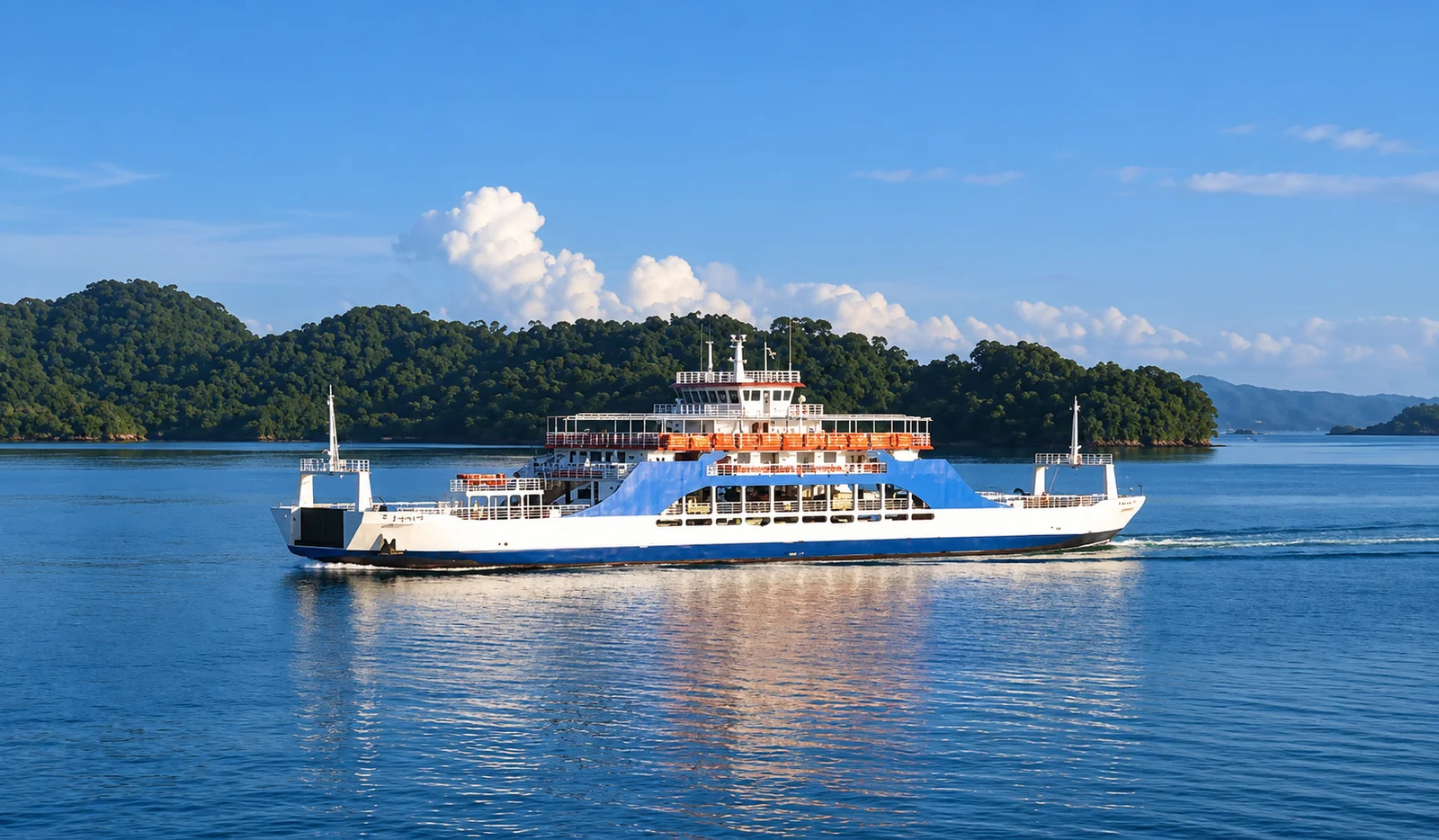
Getting to Montezuma: Which Ferry Crossing to Aim For
Eight crossings a day run to Paquera. Only two or three of them fit a couple landing at SJO.
 Marta Daví
Aim for the 9:00am or the 12:00 noon crossing out of Puntarenas on the day you land, and plan a 6:30am or 9:00am return on the day you fly home. Naviera Tambor publishes eight departures a day in each direction between Puntarenas and Paquera, and the one you catch decides whether you roll into Montezuma in daylight or take the peninsula's hills after dark.
Montezuma is not far from San Jose in a straight line. It is far in a way that maps handle badly, because the Gulf of Nicoya sits in the middle of it and the gulf runs on a timetable. Pick the crossing first. Build the rest of the day backwards from it.
The published timetable
Naviera Tambor operates the Puntarenas to Paquera route, an 11 nautical mile run across the gulf, and lists these departures on its own schedule page. The schedule is marked effective from 20 April 2026 until further notice, so check it again close to your dates.
Leaves Puntarenas | Leaves Paquera |
|---|---|
4:00am | 4:00am |
6:30am | 6:30am |
9:00am | 9:00am |
12:00 noon | 12:00 noon |
3:00pm | 3:00pm |
6:00pm | 6:00pm |
8:00pm | 8:00pm |
10:00pm | 10:00pm |
Source: Naviera Tambor, horarios y tarifas, checked 24 September 2026.
Paquera is where the boat lands. It is not where you are going. Montezuma sits at the far southern tip of the peninsula, past Cobano, and that last stretch is winding coastal road rather than highway.
Which crossing fits a day you land at SJO?
If your flight touches down in the morning, the 12:00 noon boat is the realistic one, and the 3:00pm is the safe one. The 9:00am works only if you landed the night before or very early. Anything from 6:00pm on means arriving at Paquera in the dark with the peninsula still ahead of you.
That last point is the one worth sitting with. The 6:00pm, 8:00pm and 10:00pm crossings exist because people live and work on both sides of this gulf, not because they are good tourist arrivals. On a first trip, with a rental car you collected hours earlier, unfamiliar hills in the dark is a poor first hour of a holiday.
If your inbound flight lands late, the better move is usually a night on the mainland and a morning crossing, the same logic that applies to a late landing anywhere in Costa Rica. You lose an evening. You do not lose a day to a tense drive.

Plan the departure before you plan the arrival
Almost everyone plans the way in and improvises the way out. In Montezuma that is backwards, because the return leg has two moving parts stacked on each other: the road up to Paquera, then a boat that leaves when it leaves, then a mainland drive to the airport.
Work back from your flight. An international departure from SJO in the middle of the day generally means the 6:30am boat off the peninsula, which means leaving Montezuma while it is still dark. A late afternoon flight opens up the 9:00am. There is no version of this where the noon boat rescues a mid afternoon flight comfortably.
Couples who discover this on the last night tend to spend that night doing arithmetic instead of eating dinner slowly. Do the arithmetic when you book.
What the crossing costs
Naviera Tambor publishes its fares in colones, with passengers and vehicles listed separately on the same table. Vehicle rates are shown before I.V.A.
Fare line | Published rate, colones |
|---|---|
Adult passenger | 810 |
Child passenger | 480 |
Senior passenger | 0 |
Bicycle | 2,200 plus I.V.A. |
Motorcycle | 3,400 plus I.V.A. |
Light vehicle | 11,400 plus I.V.A. |
Microbus | 18,300 plus I.V.A. |
Source: Naviera Tambor, horarios y tarifas, checked 24 September 2026.
The headline here is that the boat is cheap. Whatever this crossing costs you, it is not money, it is schedule. Budget your attention accordingly.
Can we skip the ferry and drive around?
Yes. The overland route goes around the top of the gulf, crosses the Tempisque river on the Puente La Amistad, and comes back down the peninsula. Plenty of travelers prefer it, and the reasons they give are consistent: no timetable, no queue, no risk of watching a boat leave.
The tradeoff is that you trade a scheduled crossing for a long stretch of driving, and the further south you go on the peninsula the more the roads ask of you. The overland option makes most sense when you are coming from the north anyway, say from Guanacaste or from Monteverde, when the detour is smaller than it looks on a map.
Coming from San Jose or from SJO, the ferry is usually the cleaner answer, precisely because it turns an unknown drive into a known departure time.

What about flying?
There is a domestic air option into this corner of the Nicoya peninsula, but we are not going to quote you a schedule or an airstrip here, because we could not confirm the current one against the airline's own published timetable while writing this. Which strip serves the Cobano and Montezuma area has changed in recent years, and a wrong airport on a travel day is an expensive mistake. Check the airline directly for your dates, or ask us and we will check it with you.
We would rather tell you what we could not verify than hand you a confident sentence that ages badly.
After Paquera, the road does the rest
Once the ramp goes down at Paquera, the gulf stops being your problem and the peninsula starts. The route runs inland and up before it comes back down to the coast, through Cobano, and it is hilly and curvy in a way that makes the final half hour feel longer than the distance suggests.
Do you need a 4x4 for the Cobano road?
No. A standard car is fine. Here is Dallas and Marta's read on it as of now: the Cobano road is a little better than it was, but it still has deep potholes. You can drive it in a normal car without needing a 4x4. Go slowly, little by little, so you have time to steer around the holes instead of dropping a wheel into one.
That is also the quiet argument for a daylight crossing. Potholes you can see and dodge at noon are potholes you simply hit at nine at night, in rain, in a car you collected that morning. None of this road is alarming in daylight. It is just more than most people want on arrival day.
If you would rather not drive any of it
Plenty of couples come to Montezuma and never want a steering wheel in their hands. That is a reasonable way to do this trip, and it changes the planning rather than ending it: the crossing still sets your day, the timing still matters, and someone still has to be on the mainland side at the right hour.
That is the part we do. Tell us your flight numbers and where you want to sleep the first night, and we will tell you which crossing your day actually fits, then coordinate the ground side around it.
If you are still deciding how you want to move around the country generally, our honest comparison of rental cars, shuttles and buses covers the wider question, and our Nosara guide covers the other half of the Nicoya peninsula if you are thinking about combining the two.
So: send us your dates and your flight times, and ask which crossing they fit. We will answer with the boat, the hour you need to leave, and what that does to your first evening in Montezuma.
Toorizta is how modern travelers plan, book and share Costa Rica trips. Open the app to build your own.
Open the Toorizta app