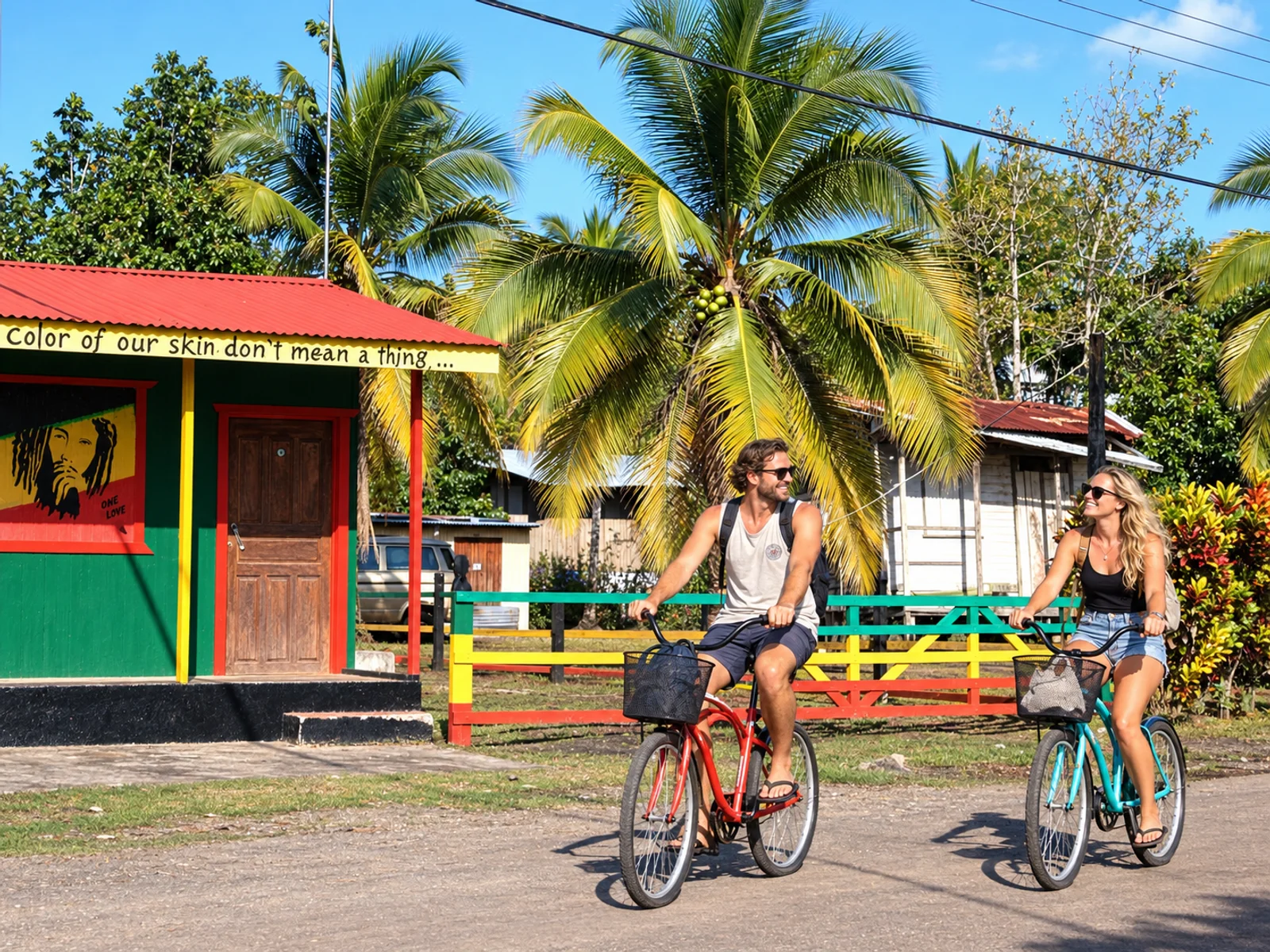
Why Smart Couples Skip the Rental Car in Puerto Viejo
Bikes cover more of the Caribbean coast than you think. Here are the four moments they do not.
 Dallas Rogers
In short: in Puerto Viejo de Talamanca the useful question is not "car or no car." It is which four moments of your stay stop working without one. Most couples sleeping in town, Playa Negra or Cocles can run the week on a rented bike, the local bus and a couple of taxis. The four moments below are the ones worth planning around, and only one of them usually argues for a vehicle.
The short answer
The south Caribbean coast is built along one road. It runs from Puerto Viejo town south past the beaches and ends at Manzanillo. It is flat, and people ride it all day on single speed bikes with baskets. That is why the standard advice, "you do not need a car in Puerto Viejo," is mostly right.
Mostly right is not the same as planned. A rental car in Puerto Viejo is not wrong, it is just usually parked. What you are actually buying when you rent one is a solution to four specific problems, and three of those four have cheaper solutions.
The four moments that break a bike only plan
1. Arrival day and departure day
This is the real transport decision, and it happens before you ever see a bike. Getting from San José to the Caribbean coast is a long half day with luggage, and how you do it sets the tone of the trip.
The public option is genuinely good here. Autotransportes MEPE runs the route, and on its own English timetable, read on 21 September 2026, it lists five direct departures a day from San José to Puerto Viejo (6:00 a.m., 8:00 a.m., 10:00 a.m., 2:00 p.m. and 4:00 p.m.), with five coming back, and it gives an approximate travel time of 4.30 hours. Fares are published on the same site. If you would rather not manage bags, connections and a fixed departure on the day you land, a private transfer does that job, and it is the one place on this coast where paying for a vehicle reliably buys something real. More on that leg in our guide to San José to Puerto Viejo.
2. Getting home after dinner
The coast road has no streetlights worth the name once you leave town. The restaurants worth the ride are spread along it, and pedalling back to Cocles or Punta Uva in the dark is the one part of the bike plan we would not romanticise.
This is a taxi, and it is the cheapest solution to the problem. Agree the fare before you get in, because there is no meter on these runs. If you want to drink wine with dinner and not think about it, book somewhere in walking distance of where you want to eat, and keep the bikes for daylight.
3. Anything inland
The bike plan covers the coast. It does not cover the Talamanca foothills. A cacao farm above Bribrí, a waterfall on a back road, the indigenous territories inland: these are not bike trips, and the bus does not go where you want on the schedule you want.
That is a driver day or a guided day, not a rental car week. One arranged day costs less than seven days of rental, insurance and fuel, and somebody else handles the back roads.
4. A fixed start time on a wet morning
If you have a boat, a tour or a flight with a departure time, weather stops being scenery and becomes logistics. Which brings us to the thing almost every Costa Rica guide gets wrong for this coast.
The rain advice you have been given is for the other coast
"Do everything in the morning, before the afternoon rain" is Pacific advice. It does not describe the Caribbean.
Costa Rica's national meteorological institute, the IMN, describes the Caribbean slope in its regional climate document as having no defined dry season: rainfall holds between 100 and 200 mm even in the least rainy months, which the institute notes is still a considerable amount of rain. The same document says the coast has two relatively drier periods, February to March and September to October, that December is the wettest month, and that rain here is most likely at night and in the morning.
Read that last part again, because it changes your day. On this coast the sky often clears as the morning burns off. A slow start, breakfast in town, and a ride south in the early afternoon is frequently the better plan, which is the opposite of what you would do in Manuel Antonio or La Fortuna.
It also explains the September and October note. The weeks that read as the wettest time of year on a national rainfall chart are one of the drier windows on the Caribbean side. That is the honest version of the green season pitch for this coast, and it is the reason the Caribbean deserves a second look when your dates land in September or October.

Where you sleep decides most of this
The car question answers itself once you know which bed you are in. This is the single biggest variable, which is why the hotel question comes before the transport question.
| Where you sleep | Can you run the week on bikes? | The catch |
|---|---|---|
| Puerto Viejo town or Playa Negra | Yes | You are in the noisy, fun part. Restaurants are walkable. |
| Cocles | Yes | A short ride to town. Plan a taxi for late dinners. |
| Playa Chiquita or Punta Uva | Mostly | Beautiful and quiet. Longer ride, so evenings need a taxi or a plan. |
| Manzanillo | Not really | End of the road. Lovely, but you are on bus times or paying for every trip. |
If that table is doing the deciding for you, read it next to where to stay in Puerto Viejo and the beaches themselves, because the two choices are the same choice.
Cahuita is the easiest car free day trip on this coast
Cahuita National Park sits north of Puerto Viejo, and it is the day trip that rewards not having a car.
According to SINAC, the national parks authority, on its Cahuita park page read on 21 September 2026: the Playa Blanca entrance is adjacent to the town of Cahuita and entry there is a voluntary contribution paid in cash, while the Puerto Vargas sector charges non resident foreigners 5.65 US dollars including tax and accepts cards. SINAC lists both sectors as open every day from 8 a.m. to 4 p.m. Parking exists at Puerto Vargas only.
So the drivers park at one end and the bus passengers walk in at the other, straight from town, past the point where the trail meets the beach. SINAC calls the reef here the most developed on the Costa Rican Caribbean, and recommends hiring a local guide, which is good advice: the guides on this trail find the sloths and snakes you would walk straight past. Our full Cahuita National Park guide has the rest.
What the bus actually costs
Published fares from Autotransportes MEPE's own site, read on 21 September 2026. Colones, normal fare first, senior fare second. Check the operator before you travel, because fares and timetables change.
| Route | Normal | Senior |
|---|---|---|
| San José to Puerto Viejo | ₡6,985 | ₡5,240 |
| San José to Cahuita | ₡6,005 | ₡4,505 |
| Limón to Puerto Viejo | ₡2,300 | ₡1,725 |
| Limón to Manzanillo | ₡3,145 | ₡2,360 |
One detail worth knowing before you book a hotel in Manzanillo: on MEPE's San José to Manzanillo timetable, read the same day, a single direct departure is listed, at 12:00 p.m., with an approximate travel time of 5.30 hours, and the 6:00 a.m. return is flagged by the operator itself as subject to change. Most people ride to Puerto Viejo and continue locally instead. That is fine for a day trip. It is a lot to build a week on.
How we would decide it
Ask yourself three questions in this order. Where are we sleeping. How many days do we want to spend off the coast road. Will both of us ride a bike in the heat.
Two yeses and a walkable hotel, and you do not need a car. One person who will not ride, or three inland days, and the maths flips fast. There is also a middle answer almost nobody considers: skip the rental, and buy a driver for the two days that actually need one.
If you want somebody to look at your specific dates and hotel and say which of those you are, ask us. Tell us where you are sleeping and what you want to see inland, and we will tell you honestly whether the car is worth it. It is a much better conversation to have before the rental is booked than after.
More on the coast itself in our Puerto Viejo travel guide, things to do in Puerto Viejo, and, if this is a family trip rather than a couple's week, our honest answer on safety.
Sources: Autotransportes MEPE published fare table and San José timetables (mepecr.com), read 21 September 2026. SINAC, Cahuita National Park, hours and rates (sinac.go.cr), read 21 September 2026. IMN, El clima y las regiones climáticas de Costa Rica (imn.ac.cr).
Toorizta is how modern travelers plan, book and share Costa Rica trips. Open the app to build your own.
Open the Toorizta app