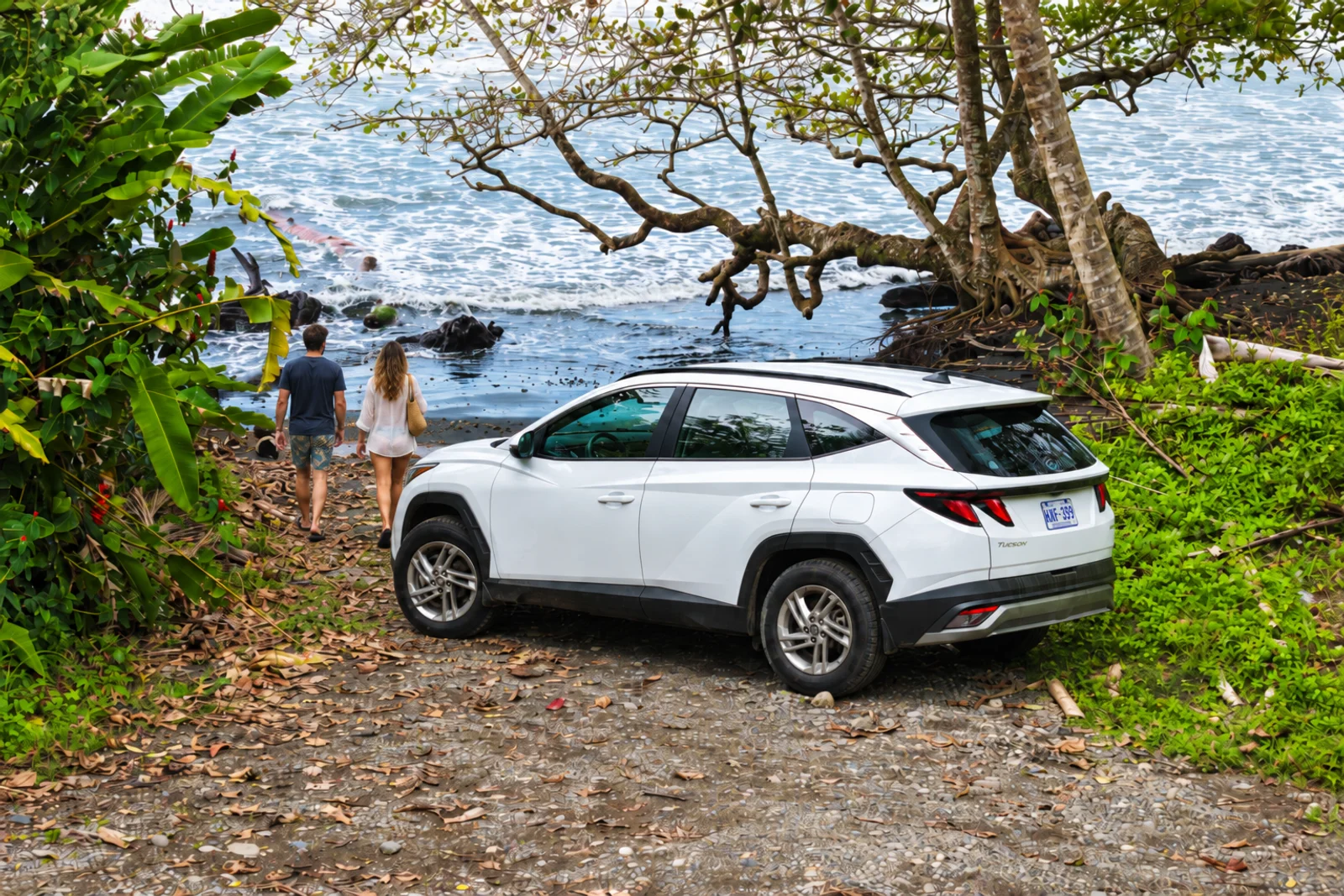
Puerto Viejo without a rental car: plan the ride home first
Bikes, buses and taxis cover this coast easily. What decides your week is what time you need to be back.
 Dallas Rogers
Short version: you do not need a rental car to have a good week in Puerto Viejo de Talamanca. Almost everything travelers come south for sits along one flat coastal road between the town and the village of Manzanillo, and Autotransportes MEPE runs a public bus up and down it all day. The thing that catches people out is not distance. It is the clock. MEPE's own published timetable shows the last northbound bus passing Puerto Viejo at 5:20 p.m., and the Gandoca-Manzanillo wildlife refuge closes its gate at 4:00 p.m. Plan the ride home and the car stops being necessary.
Do you actually need a rental car in Puerto Viejo?
For most couples staying in town or anywhere along the coast road south of it, no. The beaches, the sodas, the reef and the refuge are strung along a single flat route, and three ways of moving along it already exist: a rented bicycle, the public bus, and a taxi when the first two do not fit.
A car buys you two specific things here. It buys you freedom after the last bus, and it buys you the trips that leave the coast road, inland toward Bribri and the Talamanca foothills. If neither of those is in your plan, a car mostly buys you a parking problem.
That is the whole decision, and it is worth making before you book, because it changes where you want to sleep more than it changes anything else.
The one road that makes this work
Leave Puerto Viejo heading south and the road runs flat along the water past Playa Cocles, Playa Chiquita and Punta Uva before it ends at Manzanillo. There is no second route, no bypass and no reason to navigate. You are either going north toward Cahuita and Limón or south toward the end of the road.
That geography is why the car-free plan works so well here and why it works badly in most of Costa Rica. Our guide to the Puerto Viejo beaches is really a guide to stops along this one road.
The bus times nobody reprints
Every other page about this coast tells you to ask at your hotel for the bus schedule. MEPE publishes it. Here are the approximate pass-through times at Puerto Viejo from the operator's own Limón to Manzanillo timetable, read on 20 September 2026.
| Heading south, passes Puerto Viejo | Heading north, passes Puerto Viejo |
|---|---|
| 7:40 a.m. | 5:20 a.m. |
| 8:10 a.m. | 6:50 a.m. |
| 9:40 a.m. | 8:20 a.m. |
| 11:40 a.m. | 10:20 a.m. |
| 1:40 p.m. | 10:50 a.m. |
| 4:40 p.m. | 12:50 p.m. |
| 6:40 p.m. | 1:50 p.m. |
| 3:50 p.m. | |
| 4:20 p.m. | |
| 5:20 p.m. |
Source: Autotransportes MEPE, Limón / Manzanillo schedule, read 20 September 2026. MEPE lists slightly different departures on Saturdays and Sundays and asks travelers to call about holidays, so treat these as the working shape of the day rather than a guarantee, and check the page before you build a plan around one bus.
Two numbers fall out of that table and they are the ones worth writing down. Puerto Viejo to Manzanillo is about twenty minutes. Puerto Viejo to Cahuita is about twenty five.
What time is the last bus back?
The last northbound service passes Puerto Viejo at about 5:20 p.m., leaving Manzanillo at 5:00 p.m. Southbound, the final bus out of Puerto Viejo toward Manzanillo passes at about 6:40 p.m., which gets you down the coast but not back again. If your day runs past those, you are walking, riding or paying for a taxi.
Bikes: what they are genuinely good for
A bicycle is the best tool on this coast for one simple reason. The road is flat, the beaches sit close together, and a bike lets you stop at the one that looks right instead of the one you committed to at breakfast.
Rental shops cluster around the town centre and rent by the day. Rates move around by season and by shop, so ask two of them rather than trusting a figure you read online. Check the brakes before you ride off, ask whether a lock comes with it, and ask where they want the bike left overnight.
Ride on the right, and ride like the road is shared, because it is. Cars, delivery trucks, dogs and other cyclists all use the same strip of asphalt, and in places there is no shoulder to speak of.
The honest limit of a bike is the trip back after dark. Dusk here is quick and there is not much of it. If dinner is going to run late and you are staying out toward Punta Uva, arrange the taxi earlier in the day rather than deciding at 9 p.m.
Taxis and tuk-tuks
Taxis fill the gaps the bus and the bike leave: luggage days, heavy rain, late dinners, and any evening where somebody in the group does not want to ride. Tuk-tuks work the same stretch of road.
There is no meter culture here, so agree the fare before you get in rather than after. Ask your hotel or your rental shop what a given trip normally runs before you negotiate. They quote that number every day, and you will only quote it once.
A car-free day to Manzanillo that actually works
This is the day most people are really asking about, so here is the version that fits the published times.
Take the 9:40 a.m. or 11:40 a.m. bus south out of Puerto Viejo and you are in Manzanillo about twenty minutes later. The Refugio Nacional de Vida Silvestre Gandoca-Manzanillo starts at the edge of the village, and SINAC lists its hours as 8:00 a.m. to 4:00 p.m., Monday through Sunday. Walk the coastal trail, swim, eat in the village, then take the 3:50 p.m. or the 5:20 p.m. bus back through town.
One thing to sort out on the day rather than in advance: the refuge's own SINAC page says there is no entry charge, while SINAC's separate national fee schedule for protected areas lists a rate for Gandoca-Manzanillo. We cannot reconcile those two official documents, so carry small cash and ask at the ranger station instead of assuming either way.
If Cahuita is the day instead, the same logic runs in the other direction. You ride up on a northbound bus and you come back on a southbound one, and the last southbound bus toward Puerto Viejo passes Cahuita at about 6:15 p.m. Our Cahuita National Park guide covers the trail itself.
When the rain changes the plan
The southern Caribbean runs on its own weather rhythm, and the green season rules you read for Manuel Antonio or Guanacaste do not transfer cleanly to this coast. It rains here in most months. That is what the jungle pressing up against the road is made of.
What rain changes is the transport answer, not the trip. A downpour turns a pleasant flat ride into a cold one with no visibility, and it is the most common reason a bike day quietly becomes a taxi day. Expect that once or twice in a week rather than being surprised by it.

Where the car-free plan gets harder
Being straight about this matters more than selling the romantic version.
It gets harder if you arrive with a lot of luggage and sleep well south of town, because the first and last transfer is the awkward one. It gets harder if you have tour pickups that start before the first bus. It gets harder with small children, who do not reliably cooperate with a timetable, and it gets harder if anyone in the group has limited mobility and the walk from the bus stop is itself the problem.
None of that means you need a car for the whole stay. Usually it means you need a private transfer on two specific days and a bike for the rest, which is a lot less fuss than a week of parking.
If you are still deciding how to arrive in the first place, our San José to Puerto Viejo piece covers the transfer itself, and renting a car in Costa Rica covers what a rental involves nationally if you decide you want one. For everything else in the area, start with the Puerto Viejo travel guide and the list of things to do around Puerto Viejo.
Tell us where you are sleeping
The right answer depends on two things we cannot guess: which stretch of the coast road you booked, and what your days look like. Someone in a cabina in town with nothing fixed needs a bike and nothing else. Someone out past Punta Uva with a sunset dinner booked and an early tour needs two rides arranged before they land.
Send us your dates and where you are staying, and we will tell you which days on this coast want a vehicle and which ones are better without one. Pura Vida. 🍃
Toorizta is how modern travelers plan, book and share Costa Rica trips. Open the app to build your own.
Open the Toorizta app