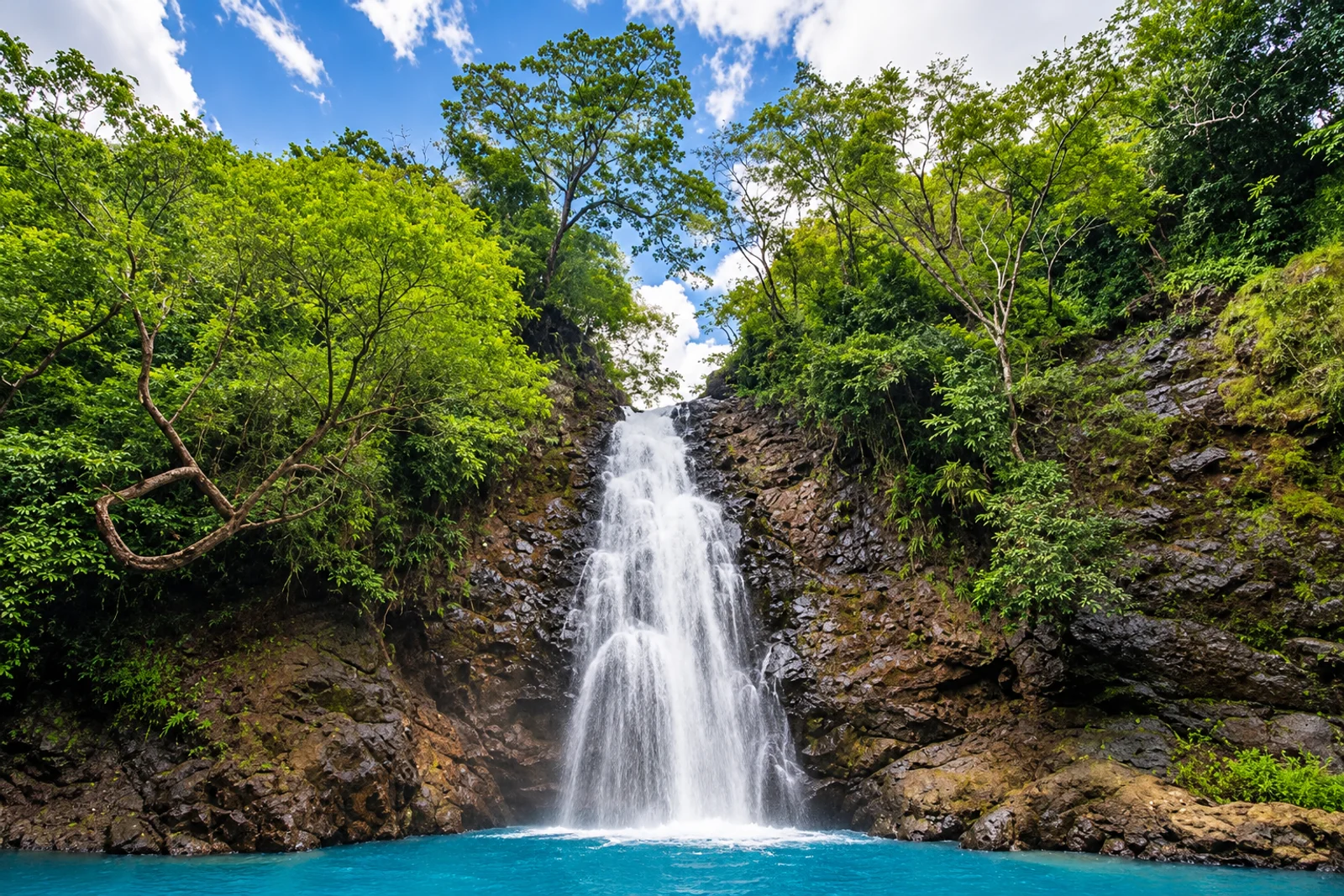
The Montezuma Waterfall Is Three Falls and Two Trails. Pick the Right One.
The riverbed scramble from town and the stair route on the hill do not lead to the same place, and they do not suit the same group. How to choose before you set off.
 Marta Daví
Short answer: there are three falls and two separate ways in. The riverbed trail from the edge of Montezuma village is free to walk and leads to the lower fall, the tall one with the big swimming pool. The upper falls are reached from a different entrance up on the hill, across private land, where the operator collects a small cash fee at the gate. Choose your entrance by the least sure footed person in your group, not by the photo that made you want to come.
Almost every argument you will read about this place comes from people describing different trails and assuming they walked the same one. One traveller calls it an easy twenty minute stroll with kids. Another lists it among the most dangerous hikes they have done. Both can be telling the truth, because they did not go the same way.
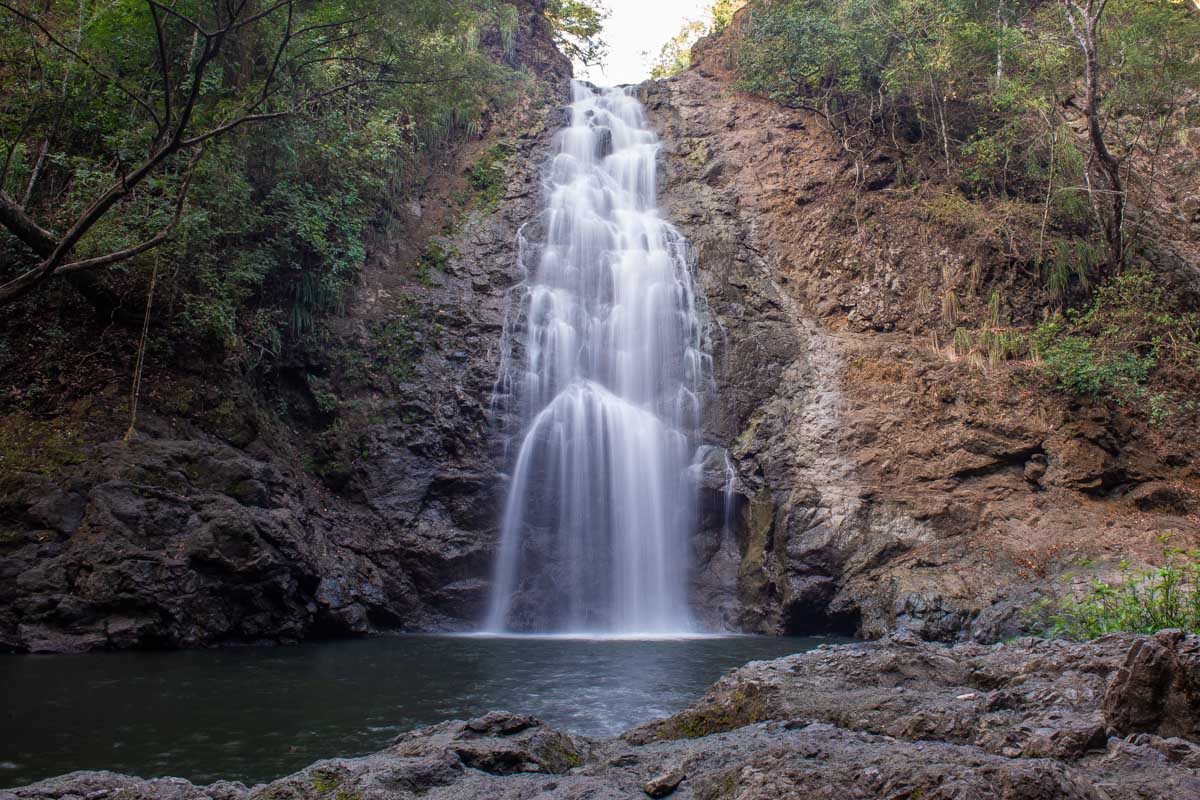 Montezuma WaterfallsSanta Teresa, Costa RicaTucked away in the lush jungles of the Nicoya Peninsula in Costa Rica, the Montezuma Waterfalls stand as a testament to the raw beauty and power of nature. Cascading down rugged cliffs surrounded by dense vegetation, these enchanting waterfalls offer visitors a serene oasis where they can immerse themselves in the sights and sounds of the rainforest while rejuvenating in refreshing natural pools. Key Points to Consider: Spectacular Scenery: The Montezuma Waterfalls boast breathtaking natural…
Why the advice contradicts itself
Montezuma Waterfall is not one waterfall. The Montezuma River drops in a series of falls behind the village, and the two best known pools sit at different heights with no easy connection between them for a casual walker.
The lower fall is the biggest single drop and has the widest pool, and it is the one in most photographs. You reach it from the riverbed trail that starts just past the small bridge on the main road out of town, where there is a dirt parking area. The upper falls are smaller and quieter, with a rope swing and shallower pools, and they are reached from an entrance higher up the hill through property managed by a local zip line operator, by a long flight of constructed steps.
Signage between the two is poor. AllTrails reviewers note that there are two routes and that the markings do not make clear which one you are on, which is how people end up scrambling somewhere they never meant to go.
Route one: the riverbed trail from town
This is the one most visitors want, and for most groups it is the right answer.
It is free to walk. There is no gate, no ranger station and no ticket, because this is not a national park. Plan on roughly twenty to thirty minutes each way, though that depends on how fast your group moves over rock.
It is not a graded path. The route runs along and across the riverbed, over boulders, roots and slabs. The rock beside the water is polished smooth by the river and stays slippery even on dry days, there are no railings, and nobody is checking on you. Sandals are a bad idea. Wear shoes you can get wet and that grip.
If someone in your group has a bad knee, poor balance, or is carrying a toddler, split up rather than encourage them. One half walks in to the pool, the other half has a long breakfast in the village. Nobody has a better morning by being talked into boulders.
Route two: the stairs to the upper falls
The upper entrance sits on the hill, reached by car, by taxi or by a hot walk up the road. It crosses private land, and the operator charges a per person fee in cash at the gate. Published amounts differ between travel blogs and change from year to year, so treat anything you read online as a rough guide and carry small colones rather than a card.
What you get for it is a built route instead of a scramble: a long series of steps, which reviewers describe as a serious staircase, and access to the upper pools and the rope swing. You swap uncertain footing for sustained effort, and you pay for it. The route suits people who are reasonably fit but would rather not pick their way over wet boulders. It does not suit anyone who struggles with long descents, because you have to come back down the same steps.
About the jump
Videos of people leaping into a pool here circulate widely, and they are why some travellers arrive with a plan already formed.
The jump in those clips is from a ledge beside an upper pool, not from the top of the main fall. Water depth below any of these ledges changes with how much rain has fallen in the preceding days, so a pool that was deep in October may not be in March. Nobody measures it for you and nobody is stationed here to stop you.
If you want to jump, go with someone who was in that exact pool that week. If nobody in your group fits that description, swim instead. The pool at the lower fall is cold, deep enough to swim properly, and the best part of the morning anyway.
What changed beside the trail this year
Costa Rican prosecutors and the Judicial Investigation Agency are investigating tree cutting and earthworks on a hillside facing the waterfall. Inspectors from SINAC, the national parks authority, found trees cut, undergrowth stripped and a slope terraced and filled near the Montezuma River, according to a SINAC technical report dated 11 September and reported by The Tico Times on 11 October 2026. SINAC said its Cóbano office had no record of a permit for the tree cutting it observed.
The report puts the affected area at about 6,564 square metres. Of that, 554 square metres is State Natural Heritage land, which is public property under special protection, and a further 827 square metres falls inside the river's legally protected buffer zone. The case began with a complaint from the Montezuma Integral Development Association and around 200 neighbours. No one has been charged and the case remains open.
Two practical points come out of it for a visitor. Residents reported rocks falling onto the riverbank below the new retaining walls, near the trail to the waterfall, partly blocking the path. And according to the same reporting, authorities have not announced any restriction on access to the falls. The walk is open. Look up as well as down on the section below the hillside works, and stay off loose fill.
The Montezuma River also received an ecological Blue Flag award in 2024. This is a river the community has protected and is now fighting for, which is reason enough to keep to the trail, carry your rubbish out, and leave the sunscreen off before you swim.
If scrambling is not your group's idea of a morning
There is a third way to see this part of the coast, and it answers the problem of half your group hating the boulders.
The ATV route runs the jungle backroads and ridgelines behind Montezuma and finishes at the waterfall. You ride rather than scramble to get there, which changes who can come. It runs about four hours, and the live calendar currently shows departures every hour from 8:00 to 13:00, Costa Rica time, from $150 per person.

Take the earliest slot you can stand. The trails are cooler, the light is better and you are back before the afternoon heat settles in.
When to go, and when not to
Go in the morning. The pool at the lower fall sits in a steep gorge and loses direct light early in the afternoon, and the village side of the trail fills up once the day visitors arrive from Santa Teresa.
Green season, roughly May to November, gives you the fall at full volume and the forest at its best. It also puts more water over the same slick rock, which makes the riverbed route harder and sometimes not sensible at all after heavy overnight rain. If it hammered down in the night, ask at your hotel before you walk down. Dry season is the opposite trade: easier footing, thinner falls.
Building a day around it
The waterfall is a morning, not a day. What you put beside it depends on where you are sleeping and how long the drive is. Cabo Blanco, the reserve down the road, is closed on Mondays and Tuesdays, which catches people out more than anything else on this peninsula, and we wrote about planning a non surf day around that gate.
If you are still deciding where to base yourself, where to stay in Montezuma covers the town, the hill and the Cabuya side, and Montezuma or Santa Teresa is the one to read if your group is split. Getting here is its own question, and which ferry crossing to aim for will save you an afternoon.
The one thing to get right
Match the entrance to the group you actually have. The lower fall on the free riverbed trail is the better swim and the easier sell. The upper falls are for people who would rather climb steps than balance on wet rock.
Tell us who is coming, how old they are and how they feel about scrambling, and we will tell you straight which entrance to use and whether the ATV route makes more sense for your morning. Ask us. Pura Vida 🍃
Toorizta is how modern travelers plan, book and share Costa Rica trips. Open the app to build your own.
Open the Toorizta app