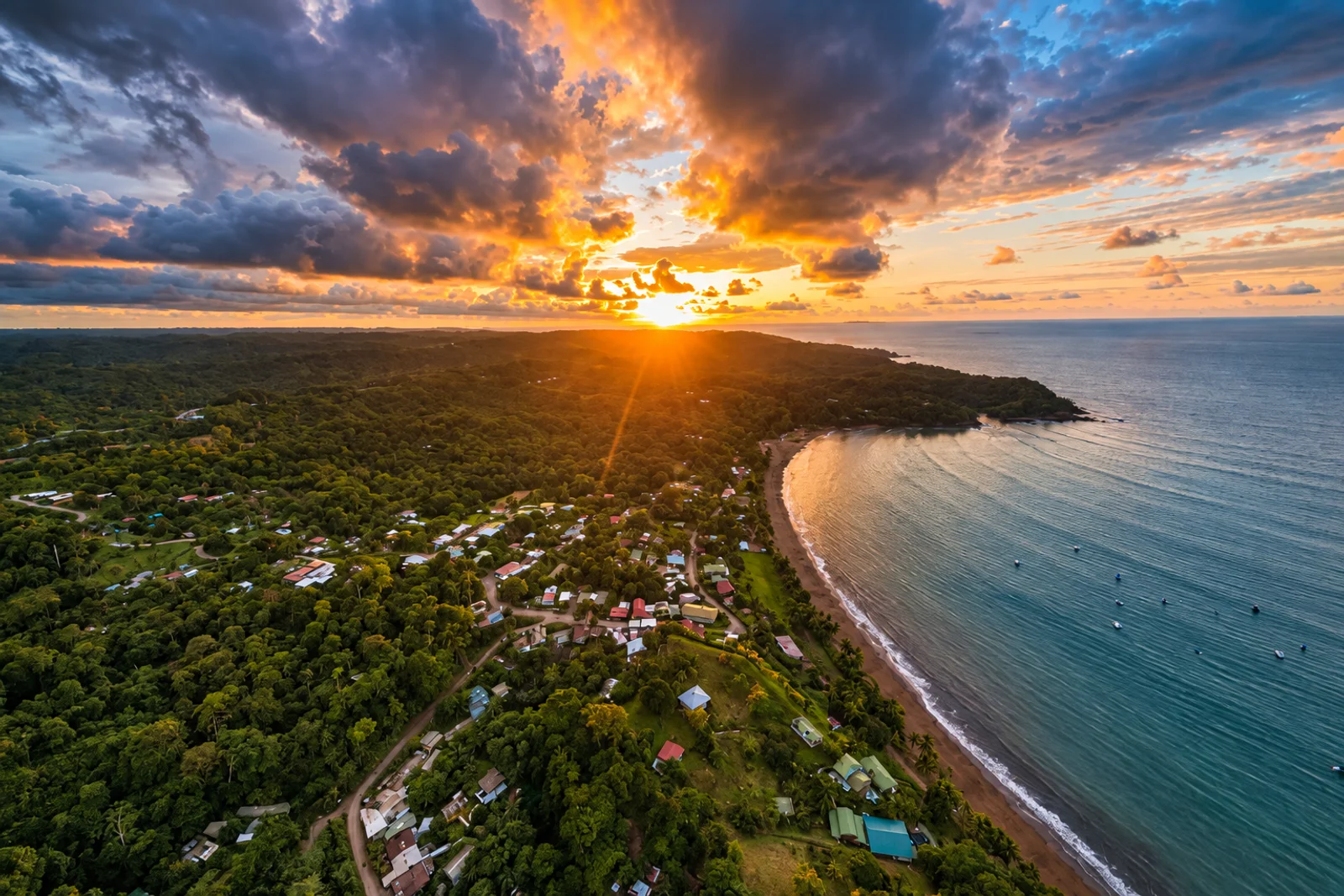
Where to stay in Drake Bay: the town, or the boat-only coast
The road stops at Agujitas. Everything south of it runs on a boat schedule, and that is the real decision.
 Marta Daví
Drake Bay has one accommodation decision that matters, and it is not luxury against budget. It is whether you sleep where the road ends, in the village of Agujitas, or south of it on a stretch of coast that boats reach and cars do not.
Choose the wrong side of that line and the week still works. It just stops being yours.
The short answer
Base in Agujitas if you want to walk to dinner, decide tomorrow's plan tonight, and keep the trip affordable. Base on the boat-only coast south of the village if the forest itself is the point and you are content to let one property feed you and move you for three days.
Almost nobody regrets either choice. People regret booking a boat-only lodge while still picturing a town they can stroll into.
Drake Bay in four lines
Agujitas is the only part of Drake Bay with a road, a cluster of restaurants, small cabinas and a beach you can walk to.
Lodges south of Agujitas along the Corcovado coast are reached by boat, and most include all meals because there is nowhere else to eat.
Corcovado National Park opens 7am to 4pm daily, and entry for foreign non-residents is $15, per SINAC's Corcovado park page.
In October, SINAC closes the Sirena sector to visitors while the park's other sectors stay open.
Why the road matters more than the room
Drake Bay sits on the northwest shoulder of the Osa Peninsula. Travelers arrive by boat down the Sierpe river, by small plane, or overland, and almost all of them land in or near Agujitas, the village at the end of the road.
Past the village, the coast turns into a run of small lodges with forest behind them and surf in front. There is no road down there. There is a footpath and there are boats.
That single fact reshapes your day more than any amenity list. A lodge on the boat-only coast is not just quieter than town. It is a place where the property decides when you leave, when you eat, and when you come back, because it owns the only practical way in and out.

Staying in Agujitas: the flexible base
Agujitas is small and working. Boats get pulled up on the sand, school kids cross the airstrip, and dinner is a short walk rather than a scheduled event.
Marta spent four days based in Agujitas, and it is the side of the line she recommends to most people. What stayed with her was how calm the place felt: sodas for every meal, nature on all sides, and the main beach close enough to walk to. The boats to Corcovado leave from there too, so the biggest day of the trip starts a few minutes from your room.
What you get. Choice. You can eat somewhere different each night, compare tour prices in person the afternoon before, take a day off without paying for a meal plan you are not using, and swap your Corcovado day if the forecast turns. Budget cabinas and family-run sodas keep the daily spend far below the all-inclusive lodges.
What you give up. Polish. Agujitas is a working village with generators, dogs and roosters in it, though the overall pace is calm rather than busy. The water in front of the village is also a landing where boats come and go, so the quieter swimming and sunset spots take a longer walk or a short ride.
One traveler on r/CostaRicaTravel put the whole dilemma in a single line: "Is it better to stay near the Drake Bay Area with some restaurants and bars or in the jungle?" That is the question, and Agujitas is the answer for anyone who wants their evenings unbooked.
Staying on the boat-only coast: the immersive base
South of the village, the lodges sit in their own clearings with the forest pressing up behind them. Howlers start before the light does. Scarlet macaws cross the gap between the trees and the water with a noise like a hinge. You do not drive anywhere because there is nowhere to drive.
What you get. Wildlife at the door rather than an hour away, staff who guide as well as cook, and a structure you can stop thinking about. Meals are included at most of these properties for the practical reason that there is no alternative kitchen within walking distance.
What you give up. Spontaneity, and a cheaper week. The boat is the schedule. If the lodge runs its Corcovado trip on Tuesday, you go on Tuesday. If you decide at 4pm that you want dinner somewhere else, you do not.
Nights are the part people underestimate. There is no light pollution down there, which is why a kayak through bioluminescence in the mangroves is one of the genuinely strange pleasures of this coast, and also why a walk back along an unlit footpath after dark is not something you improvise.
Side by side
Agujitas town | Boat-only coast | |
|---|---|---|
Access | Road and boat | Boat, or a coastal footpath |
Meals | Restaurants and sodas, pay as you go | Usually included, single kitchen |
Evenings | Walk to dinner, change your mind | Fixed, at the lodge |
Day trips | Book locally, swap dates | On the lodge's departure schedule |
Nights | Village sound, generators | Forest and surf, very dark |
Cost shape | Lower base, variable | Higher base, predictable |
Best for | Independent travelers, longer stays, tighter budgets | Wildlife-first trips, short stays, people who want it handled |
What your base does to your Corcovado day
Corcovado is why most people come, and your base changes how the day is built rather than whether you get in.
Boats from Drake Bay run to two sectors. San Pedrillo is the park's northern sector, the shorter ride from the bay. Sirena, further down the coast, is the long ride, and it is where the famous wildlife density is.
SINAC's Corcovado page lists these rules, read on 23 September 2026:
Opening hours are 7am to 4pm, every day.
Entry is $15 for foreign non-residents and $5 for non-resident children aged 2 to 12. Children under 2, and resident visitors over 65, do not pay.
Food inside the park is available only at the Sirena and El Tigre sectors, by prior reservation.
Camping costs $4 at San Pedrillo and Sirena, by reservation, and you bring your own tent.
If you overnight at Sirena station, SINAC lists lodging at $30, breakfast at $20, lunch at $25, dinner at $25, and locker rental at $4, charged per day.
Night walks are not permitted inside the park.
SINAC's own recommendations tell visitors to hire a local guide for walks in the park, and to contact local guide associations and operators to arrange one.
That last point is worth sitting with. The wildlife you came for is mostly invisible to an unaccompanied eye. A guide with a scope is the difference between a hot walk and the tapir.
Does an in-town base cost me park access?
No. The Corcovado boats leave from Agujitas, operators in the village run the same sectors the lodges do, and you book the trip rather than inherit it. The practical difference is that a town base lets you choose your date after you have seen the weather, while a lodge base usually hands you a fixed departure day as part of the package.
The October question, and it is live right now
If you are reading this looking at late-season dates, check one thing before you book anything.
SINAC's park page states that in October the Sirena sector closes its doors to visitors, while the park's other sectors remain open. San Pedrillo is not Sirena. A Drake Bay trip in October can still walk in Corcovado; it just will not be the Sirena day.
Several Drake Bay lodges also close for part of September and October. Osa is one of the wettest corners of the country, and SINAC puts the coastal zone's average annual rainfall at about 3,500mm, with the rainy season running mid-April to mid-December and the drier stretch from mid-December to mid-April.
None of that makes green season a bad idea. It does mean that in Drake Bay, more than anywhere else in Costa Rica, you confirm the property is actually open on your dates before you buy the flights. Our green season guide covers how the rest of the country behaves in those months.
One upside of the season nobody mentions: the humpbacks. Drake Bay sits in the same water as the Marino Ballena whale season, and boats going to Caño Island cross it.
How many nights, and which one is you
Three nights is the working minimum. That gives you one Corcovado day, one Caño Island or coastal day, and one day that is allowed to go wrong without wrecking the trip. Two nights means a single full day, and in a place this hard to reach, that is a poor trade. Marta's four days in Agujitas is closer to the right shape.
Choose Agujitas if you travel by feel, you want to keep the food budget yours, you are staying four nights or more, or you want to be able to move a tour because the sky looks wrong.
Choose the boat-only coast if you have three nights and want zero decisions in them, wildlife is the entire reason you picked Osa, or you are travelling with someone who will be happier with meals and departures already settled.
Choose both if you have a week. Two nights of village, three nights of forest, in that order, so the quiet lands at the end.
Getting to Drake Bay is its own puzzle, and the answer is genuinely different depending on which base you pick. Our guide to getting around Costa Rica covers the general tradeoffs, and there is broader context in things to know before visiting Costa Rica and our honest look at what Costa Rica actually costs.
Ask us
Drake Bay is the place where a generic booking goes wrong most quietly. The room photographs beautifully and the boat schedule quietly eats two of your four days.
Tell us your dates, how many nights you have on the Osa, and whether you would rather walk to dinner or hear the forest. Marta has slept in Agujitas and can tell you what the mornings are like there, and we will say so plainly if the answer is that your dates do not suit Drake Bay at all.
Send us a message and we will answer it ourselves.
Toorizta is how modern travelers plan, book and share Costa Rica trips. Open the app to build your own.
Open the Toorizta app