Which Tortuguero Tour to Book First: the Two Canals Motorboats Cannot Enter
SINAC reserves Caño Chiquero and Caño Mora for canoes, kayaks and electric motors. That single rule decides which tour is worth your best morning.
 Dallas Rogers
Short answer: book a paddle trip into Caño Chiquero and Caño Mora first. Those two narrow waterways are the best wildlife water in Tortuguero National Park, and SINAC reserves them for canoes, kayaks and electric motors only. A gas powered launch cannot go in. If your dates fall in the nesting months, the night turtle program is your second booking. Everything else can wait until you are standing on the dock.
Most of what you read about Tortuguero argues about how many nights you need. That is the wrong first question. The park publishes a map of five water trails, and it marks which craft may enter each one. Book the wrong boat and you will spend your morning on the wide channels looking at the same riverbank as everyone else, wondering why the photos looked so much closer.
The rule that decides your morning
Here is the park's own layout, from the SINAC Tortuguero National Park page and the park brochure, both read on 8 October 2026.
| Water trail | Length | What may enter |
|---|---|---|
| Río Tortuguero | 4.29 km | Motorboats. This is the gateway into the canal sector |
| Caño Chiquero and Caño Mora | 2.3 km, splitting at about 1,900 m | Small non polluting craft only: canoe, kayak, electric motor |
| Caño Harold | 3.5 km | Motorboats |
| Caño Palma | 5.1 km | Entered from Laguna Penitencia beside Cerro Tortuguero, not from the Río Tortuguero |
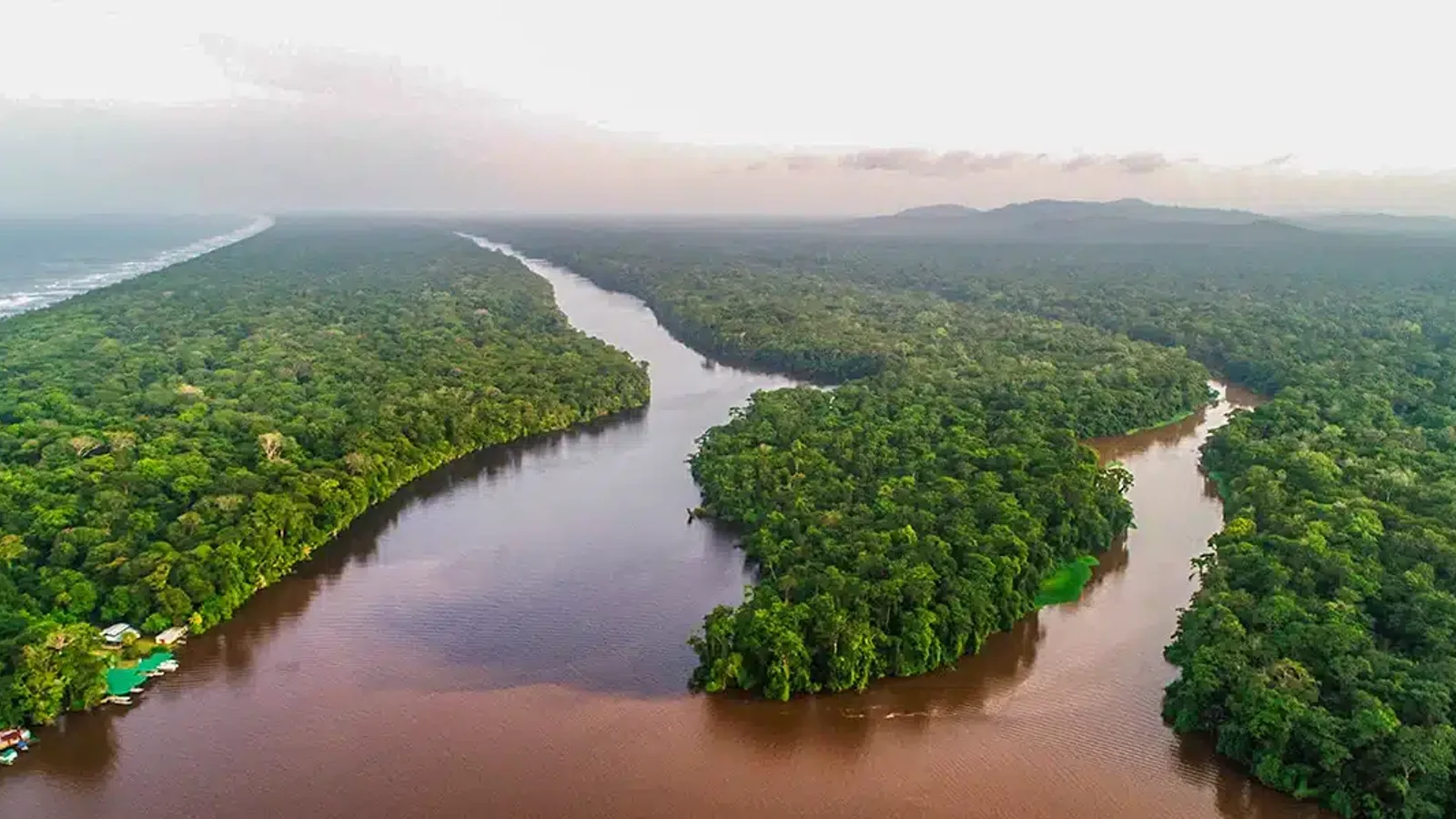
Read that second row again, because it is the whole article. The Chiquero and Mora branch runs under tall, dense forest cover, and SINAC names the spider monkey and the tolomuco, the greyheaded tayra, among what you may see there. No engine noise, no wake, and a canoe can hold still under a branch for as long as the bird does.

Caño Harold is not a consolation prize. SINAC describes it as a calm, narrow channel where reptiles are easy to watch thermoregulating on fallen trunks, which is a dry way of saying caimans and river turtles stacked on logs in the sun. If someone in your group cannot get in and out of a canoe, book Harold and stop worrying about it.
What to book, in order
One, a dawn paddle in Chiquero and Mora. Early is not a travel cliché here, it is when the water is glass and the howlers are still calling. The park opens at 6 a.m.
Two, the night turtle program, if your dates allow it. SINAC's brochure gives the turtle watching schedule as March through October, in two slots, 8 p.m. to 10 p.m. and 10 p.m. to midnight. Green turtle nesting runs June to October, leatherbacks March to May, and hatching runs September to December. The park also closes the beach from 6 p.m. to 6 a.m. between 1 March and 31 October, which is exactly why the program exists: trained spotters find a turtle that has settled, then bring small groups to her rather than letting a crowd walk the sand and turn her back to the sea. SINAC adds a sentence worth taking seriously, that you should confirm the season is open, because the animals do not read calendars.
Three, Cerro Tortuguero. Almost nobody books this and it is the odd one out in a place defined by water. It is an 1,100 m trail to a lookout 116 m above sea level, the highest ground on the entire Costa Rican Caribbean. SINAC lists this sector as open 8:00 a.m. to 3:30 p.m., at $2.26 per foreign adult with tax included. From the top you finally see what the boats cannot show you, a sheet of forest, a lagoon system, and the sea in one frame.
Four, the village. Barra del Tortuguero has no road in and no cars. Bicycles, football, a bakery, Afro Caribbean Limón cooking, and a research station with a century of turtle history behind it. Give it an unscheduled afternoon.

Tickets, hours and the money part
SINAC's Spanish language park page, read 8 October 2026, lists the Cuatro Esquinas and Jalova sectors at $16.95 for a non resident adult and $5.65 for a non resident child, tax included. Hours are every day, 6 a.m. to noon and 1 p.m. to 4 p.m., with ticket sales ending at 3:30 p.m., through the SINAC online reservation system. Cerro Tortuguero is priced and timed separately, as above.
That lunch closure catches people. A tour sold as a full day is really a morning on the water and an afternoon somewhere else, and if your boat is scheduled to start at 1 p.m. you have already missed the good light.
On guides: the turtle program runs through SINAC's trained spotters, so that one is settled for you. For the canals, spotting is the entire value of the trip. A guide who has worked the same caño for fifteen years sees the bittern you were looking straight at. Ask your operator in writing whether a guide and the park ticket are included, because the two are often sold separately.
Can you do Tortuguero in one day from San Jose?
Yes, and we run that day: the Tortuguero 1 Day Tour from San José, from $164 per person.
Be clear with yourself about what a single day can hold. The turtle program starts at 8 p.m. and the last slot ends at midnight, so no day trip from San Jose includes turtles, in any month, from any operator. A day gives you the boat ride in, canal time and the village. Turtles, a dawn paddle and a sunset need a night in Tortuguero.

When to come, and the surprise about October
Everyone assumes the Caribbean follows the rest of the country. It does not. SINAC lists July and December as Tortuguero's wettest months and March, April and October as its least rainy, on roughly 6,000 mm of rain a year. October is also the tail of green turtle nesting and the start of hatching season. That combination is the quiet argument for a trip right now, while most planners are still avoiding the word October.
Rain here is not a cancelled day either. The canals are flat, the boats are covered, and wildlife moves in the cool hour after a shower. Bring a rain layer, bring binoculars, and plan for rubber boots on the Jaguar and Gavilán trails. SINAC recommends them, which tells you something about the mud.
Two nights, in practice
A workable shape, if you are coming from the capital: night one near the airport side of San Jose or in Guápiles, then the La Pavona boat in the morning. SINAC names La Pavona, reached through Guápiles and Cariari, as the most common route in, with Caño Blanco from Siquirres serving the Jalova sector and Puerto Moín near Limón used for private boats. Two nights in the village gives you one dawn paddle, one night walk in season, the hill, and an afternoon doing nothing. Three nights is not excessive if birds are your thing.
If you are already planning the Caribbean coast, these fit beside it: where to stay in Limón, the city, the coast, or Tortuguero, how far you can actually get on a Limón port day, and which side of San Jose to sleep on the night before you head north.
The one thing to get right
Book a paddle. Everything else in Tortuguero is recoverable.
Tell us your dates and who is travelling, and we will tell you straight whether the turtle season will be open for you and whether a canoe suits your group. Ask us. Pura Vida 🍃
Toorizta is how modern travelers plan, book and share Costa Rica trips. Open the app to build your own.
Open the Toorizta app