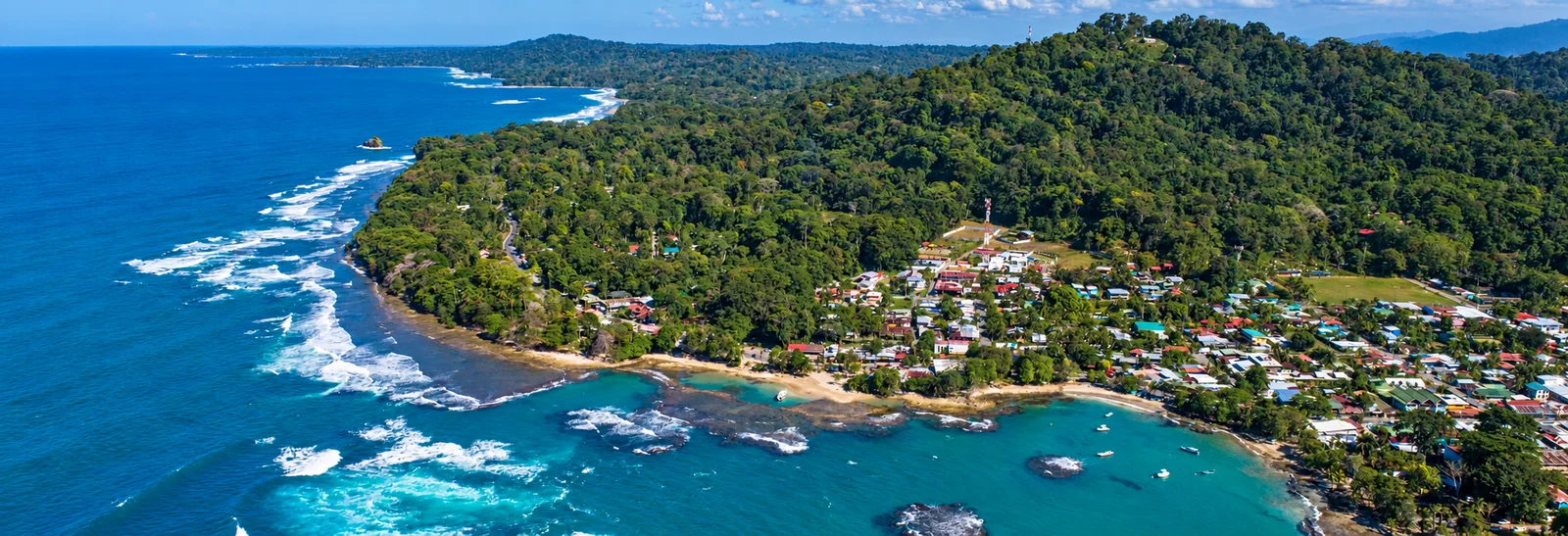
Where to Stay in Limón: the City, the Coast, or Tortuguero
Limón is a province, not a base. Here is what each bed on Costa Rica's Caribbean side is actually like to wake up in, and the one search mistake that sends families to the wrong coast.
 Marta Daví
Short answer: unless a cruise ship, a flight, or a bus connection puts you there, do not book a bed in Limón city. Base yourself in Cahuita, on the Puerto Viejo side, or in Tortuguero village itself, and choose between them by how your family wants to move around.
Here is the mistake that sends families to the wrong bed. Limón is a city and also a whole province, and most hotel search engines treat the two as one place. Ask for "the best hotels in Limón" and you get back a list that mixes an adults-only hotel on the Puerto Viejo road, a lodge reachable only by boat in Tortuguero, and a room near the port in the city. Those are not three options in one town. They are separate trips.
So the useful question is not which Limón hotel is best. It is which part of Limón province you actually want to wake up in.
Limón province covers Costa Rica's entire Caribbean coast, so a hotel listed in "Limón" may be in the port city, in Cahuita, on the Puerto Viejo road, or in Tortuguero village.
Limón city earns a night in three specific cases: a cruise call, a late arrival with an early onward move, and a connection you cannot make in daylight.
Cahuita is the quiet, walkable choice for families who want a national park at the end of the street.
Tortuguero National Park has no road access at all. SINAC's own park page states access is possible only by small boat.
If Tortuguero is the reason you were looking at Limón hotels, sleep in Tortuguero village, not in the city. SINAC names La Pavona, reached through Guápiles and Cariari, as the most common and quickest route in, and Puerto Moín outside Limón city as private boat transport only.
Which base fits which family
Base | What the morning is like | Suits | Getting around |
|---|---|---|---|
Limón city | A working port city waking up. Traffic, bakeries, cargo, almost no beach scene. | Cruise passengers, travellers with an unavoidable overnight connection | Taxis in town, buses out of town |
Cahuita | Quiet, Afro-Caribbean, a village you can cross on foot, with the national park at the end of the main street | Families with young children, slow mornings, first Caribbean visit | Walk, bicycle, occasional taxi |
Puerto Viejo side and south to Manzanillo | Surf, music, restaurants, more people, more choice of rooms | Couples, teenagers, travellers who want dinner options | Bicycle by day, taxi after dark |
Tortuguero village | Canals, rain, no cars, bicycles as the main local transport | Wildlife-first trips, turtle season, families who like boats | Boat and foot only |
When does it actually make sense to sleep in Limón city?
Three cases, and only three. A cruise call, where the ship is the hotel and the city is the gateway. A late arrival on the Caribbean side with an early onward departure, where another stretch of night driving buys nothing. And a connection that genuinely cannot be made in daylight, where one night near the terminal is the sensible, unromantic choice.
Outside those cases, the city is a place you pass through. It has real food, real music, and a cultural weight that the beach towns do not, and it is still not where a holiday morning works best. Nothing about the port is hostile to visitors. It simply was not built to be a resort, and pretending otherwise is how people end up with a week of taxi rides to somebody else's beach.
If your ship is the reason you are reading this, we have written the port day out in detail in how far you can actually get from Limón in one day.
If Tortuguero is why you were looking at Limón hotels
This is the single most expensive misunderstanding on this coast, so it is worth being exact.
Tortuguero National Park sits northeast of the city, and SINAC, the agency that runs Costa Rica's protected areas, states on its own Tortuguero page that the park is made up of an extensive network of rivers and canals and that access is possible only through small boats. There is no road to the village. SINAC's park page also notes that the surrounding communities still use the bicycle as their main form of local transport, which tells you most of what you need to know about the pace of the place.
SINAC's own "how to get there" page lists three water routes and one air route:
Route | What SINAC says | Practical reading |
|---|---|---|
La Pavona | "Most common and quickest route." Guápiles to Cariari to the Pavona dock, then boat to Tortuguero village. Continuous public and private transport. A 4x4 is preferable and is left in the dock car park. | The default way in, and it does not pass through Limón city |
Puerto Moín | "Private water transport from Puerto Limón to Tortuguero." | Charter only. No scheduled public boat to rely on |
Caño Blanco | From Siquirres to the Caño Blanco dock, then private boat only, booked with the water carriers | Niche, and it needs arranging in advance |
By air | Small aircraft on the operators' own schedules | Fastest, weather dependent, and schedules change |
Read that table again if you were planning to use Limón city as a Tortuguero base. The quickest published route in does not go through the city at all, and the route that does leave from near the city is private charter. A night in Limón city is not a shortcut to the canals. It is a detour with a boat charter attached.
Sleep in Tortuguero village instead. One night there is thin. Two is the number that lets you take a dawn canal trip, which is when the birds and the caimans are actually doing something, and still have a second morning if the rain closes in.
A few Tortuguero facts worth planning around, all from SINAC's park page:
The park is open every day, from 6 a.m. to 12 noon and from 1 p.m. to 4 p.m.
Entry for foreign non-resident adults is listed at $15, and $5 for foreign non-resident children. Some operators quote a slightly higher figure because they add the 13 percent tax, so check which number you are being shown.
Turtle nesting season runs June to October, and SINAC asks visitors to confirm the season has opened rather than assume the turtles are there.
To protect nesting turtles, beach access is restricted from 6 p.m. to 6 a.m. between 1 March and 31 October. An evening turtle walk is a guided programme with trained spotters, not a stroll you take yourself.
On rainfall, SINAC lists July and December as the wettest months at Tortuguero, and March, April and October as the driest. "Driest" on this coast still means rain.

Tortuguero, Costa Rica
Cahuita, for families who want the park at the end of the street
Cahuita sits south of the city on Route 36, the coastal road that runs south toward the Panama border. It is the base most families should look at first, and the reason is geometry rather than charm. The village is small enough to cross on foot, the main street ends at the national park entrance, and the reef is right there. You do not need to organise transport to have a good day.
That walkability is also the honest trade. Cahuita has fewer restaurants than the Puerto Viejo side, fewer rooms, and almost no nightlife. Families with young children tend to read that as a feature. Groups of friends usually do not.
If you are weighing Cahuita against the reserve further south, we compared the two walks in Cahuita or Gandoca-Manzanillo.
The Puerto Viejo side, and why your exact address matters
South of Cahuita the coast opens up into Puerto Viejo and then the string of beaches toward Manzanillo. More rooms, more food, more music, more people. For couples and for families with teenagers it is usually the better fit.
The thing to get right here is the address rather than the town. A room in the centre of Puerto Viejo puts dinner on your doorstep and a sound system within earshot. A room out toward Cocles or Playa Chiquita is quieter and prettier, and it puts a dark coastal road between you and dinner. Both are fine choices. They are not the same choice, and booking sites rarely make the difference obvious.
Two companion pieces cover the practical side of that base: what the coast road actually requires if you are deciding about a rental car, and where you sleep as the real safety question.
Is Limón safe to stay in?
The question deserves a straight answer rather than reassurance. Limón city is a port, and ports everywhere concentrate the kind of petty crime that follows cargo, bars and transient crowds. Travellers are not the target of most of it, and the habits that matter are ordinary ones: arrive in daylight, keep the airport-sized luggage out of sight, use a taxi after dark rather than walking back across town, and do not leave anything in a parked car anywhere on this coast.
What changes the answer most is not the town. It is the address and the walk home. A room on a lit street where you can reach dinner on foot is a different trip from a cheaper room that needs a dark walk each way, and that holds in Limón city, in Puerto Viejo, and in Cahuita equally.
One timing note: mid-October
Limón's carnival is the biggest event of the year on this coast. Sicultura, the Ministry of Culture's cultural registry, records that the Carnavales de Limón are now held in October, starting on 12 October as part of the province's popular festivities around Día de las Culturas.
The exact programme is set by the organising commission each year, and we could not confirm the 2026 dates on an official source, so treat the dates you find in travel articles as unconfirmed and check them before you commit. What you can plan on is the effect: if your trip touches the middle of October, city rooms get scarce and expensive, and the parades are a genuine reason to spend the night in Limón city rather than an accident.

How to pick, in one pass
Write down the one thing the trip is for. Reef and easy days, restaurants and music, or canals and wildlife.
Reef and easy days means Cahuita. Restaurants and music means the Puerto Viejo side. Canals and wildlife means Tortuguero village, reached through La Pavona.
Only then look at rooms, and check the actual address on a map before you book. If a listing says "Limón" and nothing more, that is not an address.
Book Limón city only for a ship, a connection, or the carnival.
Tell us when you land, where you land, and who is travelling, and we will tell you which of these bases fits and which one quietly costs you a day. Ask us before you book the room, not after. That is the part that is hard to undo.
Toorizta is how modern travelers plan, book and share Costa Rica trips. Open the app to build your own.
Open the Toorizta app