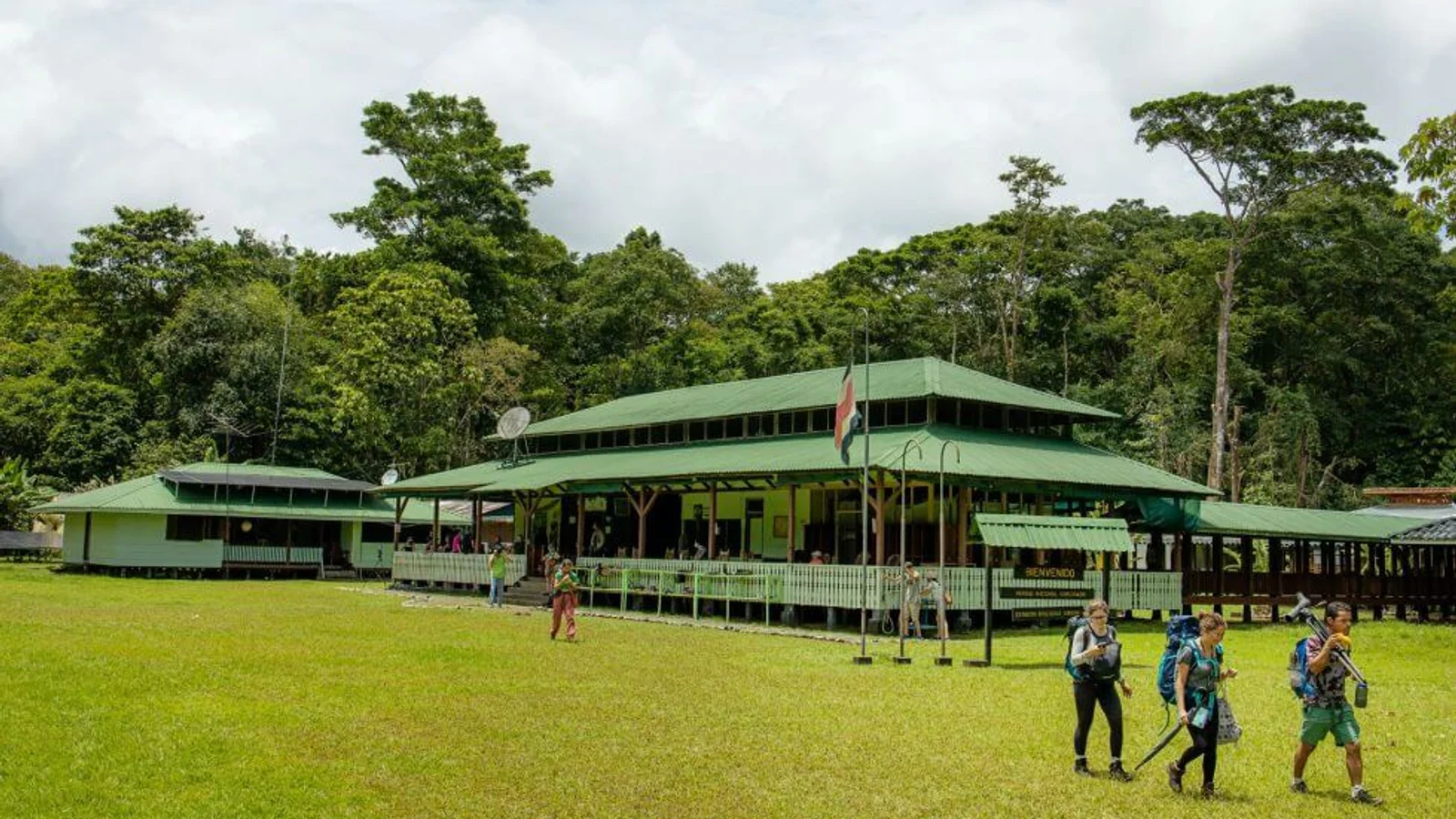
Sirena or San Pedrillo: Which Corcovado Day to Book from Drake Bay
Two ranger stations, one boat, and a reservation that closes the decision weeks before you arrive
 Dallas Rogers
The short answer. If you have one day in Corcovado National Park and you came for big wildlife, book Sirena. Book San Pedrillo if you are chasing birds, if a long open water boat ride worries you, or if your dates fall in October, when SINAC's English park page says the Sirena sector closes to visitors while the other sectors stay open.
The harder part is not the choice. It is that you cannot make it at the last minute. SINAC, the agency that runs Costa Rica's protected areas, states plainly on its Corcovado page that a prior reservation is obligatory, arranged through its reservations office by email. Your passport details go on that reservation. So the station you walk in October, or in February, is decided at a desk weeks before the boat leaves Drake Bay, which Costa Rican maps and most operators call Bahia Drake.
Here is how to make that decision once, correctly.
Sirena or San Pedrillo: the honest comparison
| Sirena | San Pedrillo | |
|---|---|---|
| Boat from Drake Bay | Longer ride, farther down the coast | Shorter ride, the sector nearest Drake Bay |
| Trails | About 20 km of local trails, including the Rio Claro pool (SINAC) | Catarata San Pedrillo 1.5 km, Llorona 7 km, Pargo Arriba and coastal 2.5 km, Marcos Reyes (SINAC) |
| Best for | Mammals: tapir, peccary, coati, monkeys | Birds, primary forest, a river and waterfall walk |
| Signature moment | Bull sharks and crocodiles visible near the Sirena river mouth at high tide (SINAC) | Walking a riverbank with nobody else on the trail |
| Food and facilities | Meals available in the Sirena sector by reservation; overnight stays possible | Bathrooms and picnic tables, no food service |
| October | SINAC's English park page says the sector closes to visitors in October | Open |
Travelers who write up both stations consistently report more large mammals at Sirena and better birding at San Pedrillo. That pattern is easy to explain. Sirena sits in the Corcovado basin with a long network of flat trails, and the animals that make Corcovado famous move through it. San Pedrillo is the northernmost sector, thick primary forest, where you hear far more than you see.
Neither is a zoo. SINAC says so itself, in its own words: it cannot assure you will live all possible experiences, because weather, tides, moons and seasons decide what walks out in front of you. Go in wanting a forest, not a checklist, and Corcovado rarely disappoints.
What SINAC actually requires before you can walk in
This is the part that surprises people, and it is the reason a Corcovado day is not a thing you arrange over breakfast.
A reservation is obligatory. SINAC's Corcovado page states that visiting the park requires a prior reservation, handled by its reservations office by email. The office is open every day from 7:00 to 16:00 and closed on public holidays. Names and passport numbers are needed, because entry is priced differently for nationals, residents and foreign visitors. That traveler who was asked for passport numbers weeks ahead was not being scammed. That is the system.
Entry fees, current on SINAC's Spanish page: 16.95 US dollars for non-resident adults, 5.65 US dollars for non-resident children aged 2 to 12. Children under 2 do not pay, and nationals and residents over 65 enter free. Ask your operator in writing whether the park fee is inside the tour price or added on the morning of the boat.
A guide. SINAC's wording is that every visitor enters through official access posts, preferably accompanied by a tourism guide properly registered with the reservations office, and that a guide is required on the La Leona to Sirena and Los Patos to Sirena routes. In practice, every day tour out of Drake Bay is guided, and that is the right way to do it anyway. In a forest this dense, the difference between a good day and a long humid walk is somebody who knows which call belongs to which bird and where the tapir sleeps.
Hours. SINAC's Spanish page lists park visiting hours of 7:00 to 15:00, while the English version of the same page lists 7:00 to 16:00. Your boat schedule governs the day either way, but it is worth confirming when your reservation is made.
The October catch
SINAC's English Corcovado page carries a line worth planning around: in October the Sirena sector closes its doors to visitors, while the other sectors stay open. The Spanish version of the same page does not repeat that line, which means one of the two is out of date.
If your trip falls in October, do not book flights, a Drake Bay hotel and a Sirena tour in that order and hope. Confirm the sector status with the reservations office first, and keep San Pedrillo as the plan. It is open, it is the closest sector to Drake Bay, and in the wettest stretch of the year the shorter boat ride is a genuine mercy.
What the day actually feels like
The boat leaves early, off a beach, not a dock. You get wet feet before you get anything else. Ride out along the Osa coastline with the forest falling straight into the water, land on sand in front of the ranger station, change your shoes, and start walking.
Then it is five or six hours of forest at a naturalist's pace, which is slower than yours. Long stops. A scope set up on a branch you would have walked straight past. Sweat, because the Osa is hot and humid, with roughly 3,500 mm of rain a year on the coastal strip and 5,500 mm up in the hills, according to SINAC. Lunch at the station. Then the boat back, usually into the afternoon wind.

Rules that catch people out, straight from SINAC's park page: no picnics inside the park, and no food may be carried into the Sirena sector at all. No single use plastic. No night walks. No swimming on the park's beaches, where the currents are dangerous. Closed shoes or rubber boots, quick drying clothes, and everything valuable inside a zip bag, because the forecast is a suggestion.
Should you try to do both stations in one day?
No. Tours exist that stitch Sirena and San Pedrillo into a single day, and they turn a wildlife day into a boat day. If you want both, give it two days and sleep at Sirena, where meals and lodging are available by reservation and where the animals are moving at dawn and dusk while the day trippers are out at sea.
If you only have one day, choose by what you want to look at. Mammals, book Sirena. Birds, forest and a waterfall, book San Pedrillo. Then reserve it early, because the decision is made on a calendar, not on the beach.
When to go
SINAC puts Corcovado's dry season from mid December to mid April, with sporadic rain, and the rainy season from mid April to mid December. Dry season means easier trails and calmer seas. Green season means fewer people, louder forest, and a boat ride that depends on the morning. If you are weighing those months across a whole trip, our green season guide lays out what the rain really does to a Costa Rica itinerary, and getting around Costa Rica covers how the Osa connects to everywhere else.
Corcovado is the biggest wildlife decision on the Pacific side, but it is not the only one. If your route runs up the coast, the whale watching season around Uvita and Marino Ballena overlaps with it. If you are also weighing a Caribbean wildlife walk, we compared Cahuita and Gandoca Manzanillo the same way, and we did the same thing for Monteverde's cloud forests and whether a naturalist is worth the money.
Ask us before you reserve
Tell us your dates, who is walking, and how everyone feels about an hour on the open Pacific. We will tell you which sector fits, what the reservation needs from you, and whether your dates run into the October question. If the answer is that Corcovado is wrong for your trip, we will tell you that too.
Pura Vida.
Toorizta is how modern travelers plan, book and share Costa Rica trips. Open the app to build your own.
Open the Toorizta app