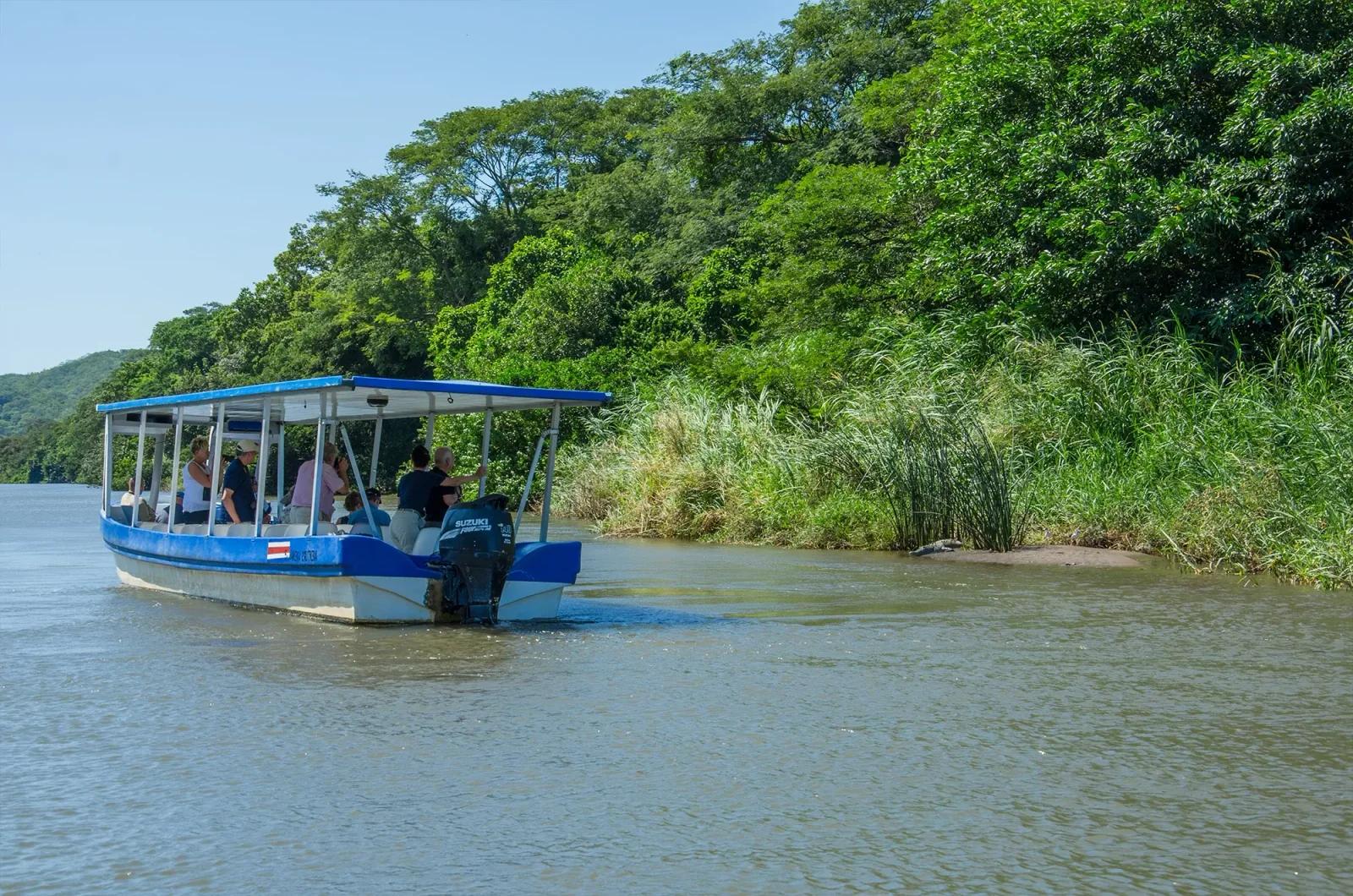
Palo Verde from Liberia: the Boat Safari and the Park Are Two Different Bookings
SINAC's own service list for Palo Verde has no boat in it. Here is where the Tempisque boats actually leave from, and how a family picks one half day.
 Marta Daví
The short answer. From Liberia, Palo Verde is two different bookings sold under one name. The boat safari is a private trip on the Rio Tempisque, run by operators from docks on the river. Palo Verde National Park is the gate, and SINAC's own list of services for the park contains trails, a lookout, drinking water and restrooms. No boat. Families with one half day almost always want the boat. Walkers and birders with a full day and a high clearance car want the gate.
So which one should you book?
Book the Tempisque boat safari if you have half a day, mixed ages in the group, and you want crocodiles, iguanas and monkeys with almost no walking. Book entry to Palo Verde National Park if you want quiet trails, a lookout over the lagoon and the Gulf of Nicoya, and you are willing to drive a long gravel road to get there.
Tempisque boat safari | Palo Verde National Park gate | |
|---|---|---|
Who runs it | private operators, from their own docks | SINAC |
Time it takes | well under two hours on the water, half a day door to door from the coast | a full day if you drive yourself |
Walking | down a ramp into the boat, and that is all | 20 m to 2,100 m of trail, some of it steep |
Best for | families, grandparents, limited mobility, a first wildlife day | birders, walkers, anyone who wants the place to themselves |
Guide | included when you book a tour, not waiting for you if you turn up alone | not included |
What you pay | the operator's price, plus the park fee if the route enters the park | $13.56 per non-resident adult at the gate, per SINAC |
What the national park sells at the gate
SINAC's page for Parque Nacional Palo Verde, read on 3 October 2026, lists the park's services as information, a lookout, trails, drinking water and restrooms. That is the full list. A boat is not on it.
The gate is open every day from 8:00 a.m. to 4:00 p.m., and SINAC states that payment is by card only. That is worth knowing before you drive a long gravel road with a pocket full of colones.
Palo Verde entrance, per SINAC, 3 October 2026 | Price |
|---|---|
Non-resident adult | $13.56 |
Non-resident child | $5.65 |
Resident adult | 1,130 colones |
Resident child | 565 colones |
The trails are short, and the two best ones for a family are the two shortest. SINAC publishes them like this:
Trail | Length | What it gives you |
|---|---|---|
Sendero Elevado La Jacana | 20 m | A raised boardwalk over Palo Verde lagoon, built for watching birds |
La Roca | 540 m | A lookout over much of the lagoon, the Tempisque and the Gulf of Nicoya |
El Pizote | 650 m | Big trees, then dry forest vegetation as you climb |
El Mapache | 710 m | Three habitats in one short walk |
La Cantera | 1,400 m | A lookout over the bends of the Tempisque |
El Guacayan (Cerros Calizos) | 1,700 m | A steep climb to the Guacayan and El Cactus lookouts |
La Venada | 2,100 m | Follows the edge of the lagoon in places |
A twenty metre boardwalk over a wetland at seven in the morning is a genuinely good thing to own for an hour. It is just not what most people picture when a hotel desk says Palo Verde.
Then where does the boat actually leave from?
Not from that ranger station. The Tempisque safaris are run by private operators from docks on the river, and their own listings are careful with the wording. One sells its trip as a safari on the Tempisque River "bordering Palo Verde National Park." Departures offered from Guanacaste hotel desks tend to leave from Puerto Humo, from Ortega, or from a private hacienda that keeps its own boats and its own lunch room.
Three things follow from that, and all three cost money or time if you find them out late.
You cannot drive to the park and expect a boat with a guide. There are often local boatmen near the water, but a boatman is not a naturalist, and the park does not sell you one. Travellers ask this constantly in forum comments: if I drive myself, where do I meet the guide and the boat? The honest answer is that you arrange the guide first, and the guide arranges the boat.
The park entrance fee is sometimes inside the tour price and sometimes not. Ask which, in writing. At $13.56 a head for non-resident adults, a family of four notices.
If your departure sits outside the park boundary, the gravel road never enters your day. For a lot of families, that is the entire argument for booking the boat and skipping the gate.
What you will see, and the one animal you will not
A version of this question appears on travel forums over and over: we want Rincon de la Vieja for the mud and the hot springs, and Palo Verde for the rainforest and the sloths, are the two too similar?
The second half of that sentence is the problem. Palo Verde is not rainforest. SINAC describes it as one of only three places left in Mesoamerica holding remnants of tropical dry forest. Sloths do not live in dry forest. If someone in your group has their heart set on a sloth, that is a separate booking on the rainforest side of Guanacaste, and it is much better said out loud at the planning stage than in the car on the way home.
What the wetlands do hand you is volume. SINAC counts more than 280 bird species in the park, around 55 reptiles and amphibians and 150 mammal species, and the wetlands make up roughly 60 percent of its 19,800 hectares. The park is a RAMSAR wetland of international importance. Isla de Pajaros, a 2.3 hectare island on the water, holds the largest black crowned night heron colony in the country.
In practice, from a boat, that reads as crocodiles and garrobos flat on the banks, iguanas in the branches, howler and white faced monkeys in the trees leaning over the channel, and herons and waterbirds in numbers that surprise people who did not come for birds. Guides will tell you a falling tide puts more crocodiles out on the mud, so the hour of your departure matters more than the boat you are on, which is the same lesson as booking a boat day in the Papagayo Gulf.
One seasonal note, offered as reasoning rather than as a fact we can source: SINAC's bird list for Palo Verde leans heavily on migratory species, which is why birders aim at the northern winter. Right now, in October, we are still in green season. More water, more green, fewer boats, and the birds spread across a flooded landscape instead of crowding the lagoon edge.

Driving yourself: the part the listings leave out
SINAC's own directions are two lines long. Take Route 1, the Interamericana Norte, as far as Bagaces, then 30 km south on a gravel road. The park's recommendations page adds that a 4x4 is preferable in the rainy season because of road conditions.
We are in the rainy season until around November, so take that seriously if your rental is a small sedan. Thirty kilometres of lastre is not dangerous. It is slow, and it is slower wet.
Two more things. The gate shuts at 4:00 p.m., so a mid afternoon start buys you very little park. And this is a poor day to treat as a transit stop with all your luggage in the car. Travellers moving from Tamarindo up to Arenal regularly ask where they can park safely with bags in the trunk, and the truthful answer for a rural ranger station is that we would not. Do the boat from a staffed dock instead, or run this as an out and back from your hotel and move the next morning.
Is a naturalist guide worth it here?
Here, more than on most Costa Rica days, yes. A wetland gives you movement, not names. Crocodiles and monkeys you will find yourself. The forty waterbirds in one dead tree, the difference between a tiger heron and a boat billed heron, the reason the whole flock lifts at once, those only exist if someone in the boat knows them.
The reverse is also true and worth saying. If your group's real appetite is one fun hour of crocodile spotting with the kids, a short boat with a good driver and no naturalist is a perfectly honest way to spend a morning, and you should not pay for the full birding treatment to get it.
If the wetlands are not your half day
Three alternatives, all closer to the Guanacaste beaches.
The Tamarindo estuary. Mangrove channels rather than open river, a shorter run, and a much shorter drive if you are staying anywhere between Tamarindo and Flamingo. It is the obvious substitute when Palo Verde is simply too far to justify.
What the estuary gives up in scale it partly wins back in closeness. You are in narrow water with the roots right beside the boat, which is a better setting for a camera and for a child's attention span.
Worth reading first, because the headline tour in Tamarindo is not what most people assume it is: what the park actually allows now, and what to book instead.
Rincon de la Vieja. The other big day out of Liberia, and a completely different landscape. If you are weighing the two, we have written the day in detail: which Rincon day to book and the ticket nobody mentions, and mud pots or waterfalls, and the two deadlines that decide.
Nothing at all, on arrival day. If you land at LIR in the afternoon, this is not the day for a wetland. Where you sleep that first night does more for the trip than any tour: airport strip, town, or drive on.
How we would place this in a Guanacaste week
Wildlife early, volcano in the middle, beach at the end. The Tempisque boat is a morning, so it pairs with an afternoon that asks nothing of you. Rincon de la Vieja is a full day and wants its own slot. Put them on consecutive days and the second one feels like a chore, so leave a beach day between them.
If you only have one of these days, and there are children or grandparents in the group, take the boat.
Ask us
The useful question is not which tour is best. It is which departure suits your group, on your dates, from where you are actually sleeping. Tell us who is in the party, whether you have a car, and what you are hoping to see, and we will tell you which dock we would send you to, whether the naturalist is worth it for you, and whether the park gate belongs in your week at all.
Message us. A straight answer is free, and it is usually shorter than another evening of tabs.
Pura Vida 🌿
Sources checked 3 October 2026: SINAC, Parque Nacional Palo Verde for hours, fees, services, trails, habitat and species counts, and Como llegar for the route and road surface. Departure points and route descriptions are as stated on operators' own public listings.
Toorizta is how modern travelers plan, book and share Costa Rica trips. Open the app to build your own.
Open the Toorizta app