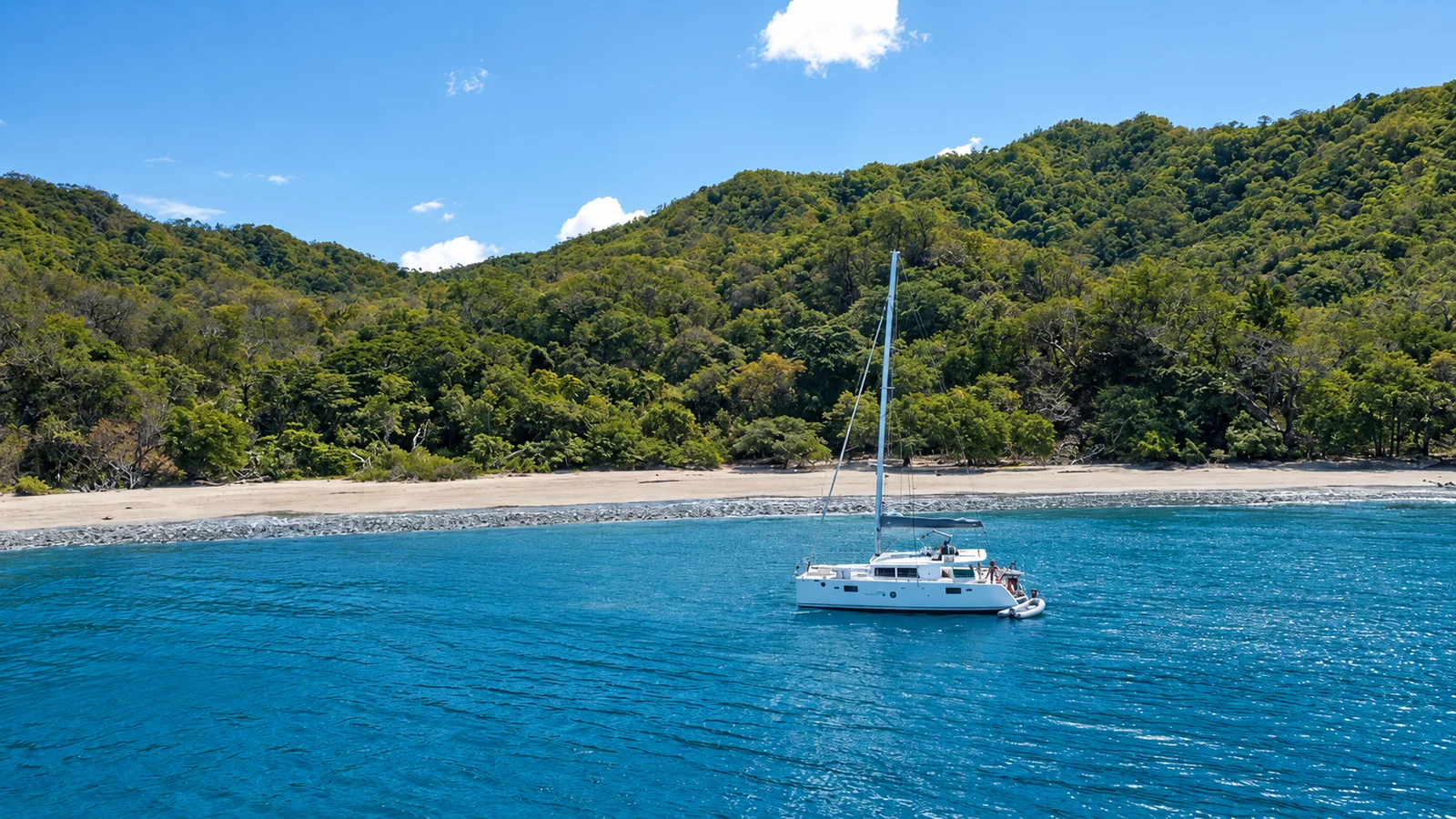
Booking a Boat Day in the Papagayo Gulf: Why the Hour Beats the Boat
Mornings are glass, afternoons are whitecaps, and February is not June. How families choose the right Guanacaste boat day.
 Marta Daví
Short answer: book the morning. In the Gulf of Papagayo the wind builds through the day, so the same boat, the same crew and the same snorkel stop can feel like a glassy cove at 8am and a washing machine at 2pm. Choose the earliest departure the operator offers, keep the sheltered water of Bahía Culebra as your plan, and treat the long open crossings as the upgrade you take on a calm day.
That one decision matters more than which vessel you pick. Families arrive in Guanacaste comparing catamarans, pangas and speedboats, then book the afternoon slot because it fits the resort day better, and end up holding a sick child over the rail while the captain shortens the route.
What changes between morning and afternoon
Early morning | Midday to late afternoon | |
|---|---|---|
Water in the gulf's coves | Usually calm, often glassy | Wind chop builds, whitecaps in the dry season |
Snorkeling comfort | Easier for first-timers and kids | Surface agitation makes masks flood and fins thrash |
Wildlife | Birds active, better light for photos | Sun high, water stirred |
Risk of a shortened or cancelled trip | Lower | Higher on windy days |
Best for | Snorkel stops, island runs, families | Sunset sails inside sheltered water |
Why the wind decides your boat day here
The Gulf of Papagayo sits at the windiest corner of Costa Rica's Pacific coast. Northeast trade winds funnel through low gaps in the Central American mountains and accelerate out over this stretch of sea, which is exactly why the wind carries the gulf's name. It is not a storm. It is a daily pattern that strengthens through the dry season and usually peaks after the sun has been up for a few hours.
Two pieces of the national record are worth knowing before you book.
First, the season. Costa Rica's Meteorological Institute describes the Pacific slope dry season as running from December through March, with April a transition month and March the driest and warmest (IMN, El clima y las regiones climáticas de Costa Rica). Those are the months when a Guanacaste boat day most needs an early start.
Second, the strength. In its advisory of 13 December 2025, the IMN forecast gusts between 30 and 50 km/h in the North Pacific region and told mariners to expect rougher seas there, singling out the North Pacific for caution at sea (IMN, Aviso Meteorológico, 13 December 2025). Gusts in that range are not dangerous for a competent captain in sheltered water. They are enough to turn an open-water crossing into an hour of slamming, and enough to make cloudy, churned-up water where you hoped to see fish.
Put those together and the pattern is simple. In high season the sea is often lovely at breakfast and tiring by lunch. The dive shops on this coast know it, which is why their advice tends to stop at "avoid the windiest days". The more useful question is what you book instead.
Which boat day to book
Three kinds of day are sold out of this corner of Guanacaste, and they do not react to wind the same way.
The day | What it suits | How the wind hits it |
|---|---|---|
A snorkel morning inside Bahía Culebra, from the beaches around Playa Panama and Playa Hermosa | Families with young or nervous swimmers, first snorkels | Least exposed. Headlands block much of the fetch, so a breezy day is still workable early |
A sail or motor cruise out of the Papagayo area or Playas del Coco with one or two stops | Mixed-age groups who want shade, a deck and a swim rather than a dive site | Moderate. Comfortable early, choppier later, and the swim stop is what suffers first |
A long run north or south to the Catalina Islands or the Bat Islands | Confident swimmers, divers, teenagers who love a fast boat | Most exposed. Open water both ways, and the first thing a captain trims on a windy day |
If you only have one boat day in the trip, take the first option on a windy week and the third on a calm one. The middle option is the safest booking when you do not yet know the forecast, because a good crew can keep a cruise inside protected water and still give you a swim.
Water temperature is the other quiet surprise. When the wind pushes surface water offshore, cooler water rises to replace it, so the gulf can feel notably colder in the windy months than the words "tropical Pacific" suggest. That same cool, nutrient-rich water is why this coast is good for big marine life in the dry season. Bring a rash guard for the kids and nobody spends the ride shivering under a towel.
Is the afternoon ever right?
Yes, for one thing. A sunset sail inside sheltered water is an afternoon trip on purpose, and the wind that ruins a snorkel stop is the same wind that fills a sail. Book the late slot when the point of the day is the deck, the light and the run back in the dark, not what you can see underwater.

What to ask before you pay
Most disappointment on this coast comes from three unasked questions. Ask them in writing, whoever you book through.
Who decides if we go, and when. A captain who calls it on the morning of the trip is protecting your day, not cancelling it casually.
What happens to our money if the sea is too rough. Rebooking to the next morning is worth more to a family than a partial refund.
Where is plan B. If the crossing is off, does the trip move to a sheltered cove, or does it simply not run.
Green season boat days, May to November
The green season flips the problem. Mornings are still the clear part of the day, and the afternoon risk becomes a build of cloud and a thunderstorm rather than a steady blow. One detail catches people out: the IMN notes that the trade wind intensifies during the July and August veranillo, the drier spell inside the rainy season, so a windy sea in midsummer is normal and not a sign that your week is ruined. Our honest guide to green season walks through how that rhythm shapes a whole itinerary.
If whales are on your family's wish list, that is a different coast and a different season, and worth planning deliberately rather than hoping a Guanacaste snorkel trip delivers it. Start with our Costa Rica whale watching guide.
Fitting the boat day into the week
Two practical habits make this easy.
Put the boat day early in your stay, not on the last full day. Then if the captain moves it for wind, you still have mornings left to use.
Second, do not schedule it for the morning after a late landing. If you are flying into Liberia, the arrival hour decides whether you sleep near the airport or push on to the coast, and a tired family at a 7am dock is nobody's good memory. We walk through that choice in where to stay when you land at Liberia.
Check the IMN advisories the evening before rather than a generic weather app icon. A forecast that mentions ráfagas, gusts, in the Pacífico Norte tells you more about your snorkel stop than a picture of a sun.
Ask us
Tell us your dates, your kids' ages and how they do in a boat, and we will tell you which Papagayo boat day fits and which hour to hold. If the forecast turns, we would rather move your morning than watch you spend it being brave. Ask us a question and we will answer with what the water is actually doing that week. Pura Vida 🍃
New to the country as well as the coast? Start with things to know before visiting Costa Rica.
Toorizta is how modern travelers plan, book and share Costa Rica trips. Open the app to build your own.
Open the Toorizta app